
How to Write a To-Do List You Will Actually Finish
Most to-do lists are not too short. They are too long, too vague and written as if tomorrow had no meetings, messages or surprises. Here is how to write one that matches the day you will really have.
Keep two lists: a master list for everything and a short list for today. Start every item with a verb, shrink each project down to its next step, and give the hardest task a time and a place. Then cut today's list to what you finished on a normal day last week, not what you hope to finish, and decide each evening where the leftovers go.
 By RytePad StaffUpdated
You write a list on Monday morning with fourteen things on it. By evening five are ticked, two meetings ran over, and the other nine slide onto Tuesday, on top of Tuesday's own fourteen. By Thursday the list reads like a record of what you did not do.
The fix is not more willpower or a better app. It is a different way of writing the list. Below is what the research says about plans and deadlines, and a seven-step method built on them.
- Keep a master list for everything and a short list for today. Mixing the two is what makes lists feel endless.
- People tend to underestimate how long their own tasks take, and in one set of studies the bias disappeared when they thought about how long similar tasks took before.
- A specific plan for an unfinished task reduced intrusive thoughts about it, even before the task was done.
- Deciding when and where you will act had a medium-to-large effect on reaching goals across 94 tests.
Why to-do lists go unfinished: three common problems
It is rarely laziness. Look closely at an unfinished list and you usually find one of these.
- It is two lists in one. "Buy milk" sits next to "sort out the pension" and "learn Spanish". When they share one page, the page can never be cleared.
- The items are labels, not actions. "Car", "Mum", "Tax". Each one makes you stop and work out what you meant, and that pause is where procrastination slips in.
- It is sized for an ideal day. It assumes no interruptions and no task that turns out bigger than it looked.
What research says makes a plan work
We underestimate how long tasks take
In 1994, Roger Buehler, Dale Griffin and Michael Ross published five studies with 465 university students. Across academic and everyday tasks, the students' predictions of when they would finish were too optimistic, a pattern known as the planning fallacy.
When asked to think aloud, people focused on how the task would go and largely ignored how similar tasks had gone before. When they were told to connect their prediction to relevant past experiences, the optimistic bias went away.
A decade later, Justin Kruger and Matt Evans found a practical fix. In five experiments, people asked to unpack a task into its parts before estimating it, from holiday shopping to formatting a document, gave longer and, in two of the experiments, less biased estimates. The more parts a task had, the more unpacking helped.
What this means for your list. Your sense of how much fits into a day is probably generous. Your record of what you actually finished last Tuesday is a better guide.
A specific plan quiets the nagging
In 2011, E. J. Masicampo and Roy Baumeister studied why unfinished tasks stay on your mind. Unfinished goals caused intrusive thoughts during an unrelated reading task and hurt performance on a word puzzle. When participants were allowed to write a specific plan for the unfinished goal, those effects disappeared, although the goal itself was still not done.
Once a plan exists, the authors suggest, the mind stops pushing the goal and picks it up again at the time you set. "Tax" keeps your brain working; "Download the bank statements on Saturday at 10" lets it rest. We look at the same idea at bedtime in our guide to writing tomorrow's list before bed.
When and where beats good intentions
Psychologist Peter Gollwitzer calls a plan that says when, where and how you will act an implementation intention. With Paschal Sheeran, he pooled 94 independent tests of the idea in 2006. Making that kind of plan had a positive effect of medium-to-large size on reaching goals, compared with simply intending to reach them.
You do not need that for "buy stamps". Save it for the task you have already moved three times.
How to write a to-do list you will finish
Seven steps. The first time takes about fifteen minutes; after that, five to ten minutes a day, and like any new habit it gets quicker with repetition.
Split it into a master list and a today list
Keep two lists, each with one job:
- Master list: everything else. Projects, errands, ideas. No date, so no deadline to fail.
- Today list: short, and tied to one date.
Each evening or morning, move a few items across. An endless list stops feeling endless once the endless part lives somewhere else.
Start every item with a verb
Call, email, book, buy, draft, pay, send. A verb turns a reminder into an instruction. Add the detail you would otherwise have to remember: not "Dentist" but "Call the dentist to move Thursday's appointment".
Shrink projects to their next step
"Plan Mum's birthday" is a project. You cannot do a project; you can only do the next piece of it. Write the first visible step instead: "Text Priya to ask which Saturday works". Keep the whole project on the master list and put only the next step on today's. Listing the parts also shows how big the job really is.
Give the hard one a when and a where
Pick the task you are most likely to avoid and attach a time and a place to it. This is the implementation intention from the research above, and it works best on the jobs you keep moving.
Example. "At 9:30, at my desk, before opening email, I will draft the report outline."
Size the list by last week, not by hope
Look back at a few recent days and count what you actually finished. If a normal workday ends with five tasks done, today's list gets five. Base the estimate on your own past, not the best case, and write fewer on days full of meetings.
Mark the one that makes the day
Ask: if only one thing on this list gets done, which one would make today a success? Mark it and put it near the top. If everything is marked, nothing is, so keep it to one, or two on a quiet day. Benjamin Franklin opened his days with a similar question, as his written daily routine shows.
Close the day on purpose
At the end of the day, look at what is left and give each item one of four decisions:
- Tomorrow
- A specific later date
- Back to the master list
- Delete it
An item that has moved three days running is usually too big (step 3), too vague (step 2) or not important.
A to-do list, before and after
A typical Monday list, as many of us write it:
- Tax
- Car
- Mum's birthday
- Emails
- Report
- Gym
- Clean the flat
- Call bank
- Learn Spanish
- Fix the shelf
- Insurance
- Groceries
The same list after the seven steps, for a day with two meetings:
- 9:30 at my desk: draft the outline of the Q4 report (one page)
- Call the bank about the duplicate charge
- Text Priya to ask which Saturday works for Mum's birthday
- Book the car service for next week
- Buy groceries on the way homeThe list lives in the Groceries checklist
- Tax return: download the bank statementsSaturday
- Fix the shelf
- Compare home insurance quotesBefore the renewal date
- Clean the flatSunday
- Learn SpanishMoved to goals, where it belongs
Five tasks, each one startable, with the hardest given a time. Nothing is forgotten; it just no longer crowds today.
Doing this in RytePad
A notebook works fine. If you want it on your phone and computer, here is how RytePad fits the method:
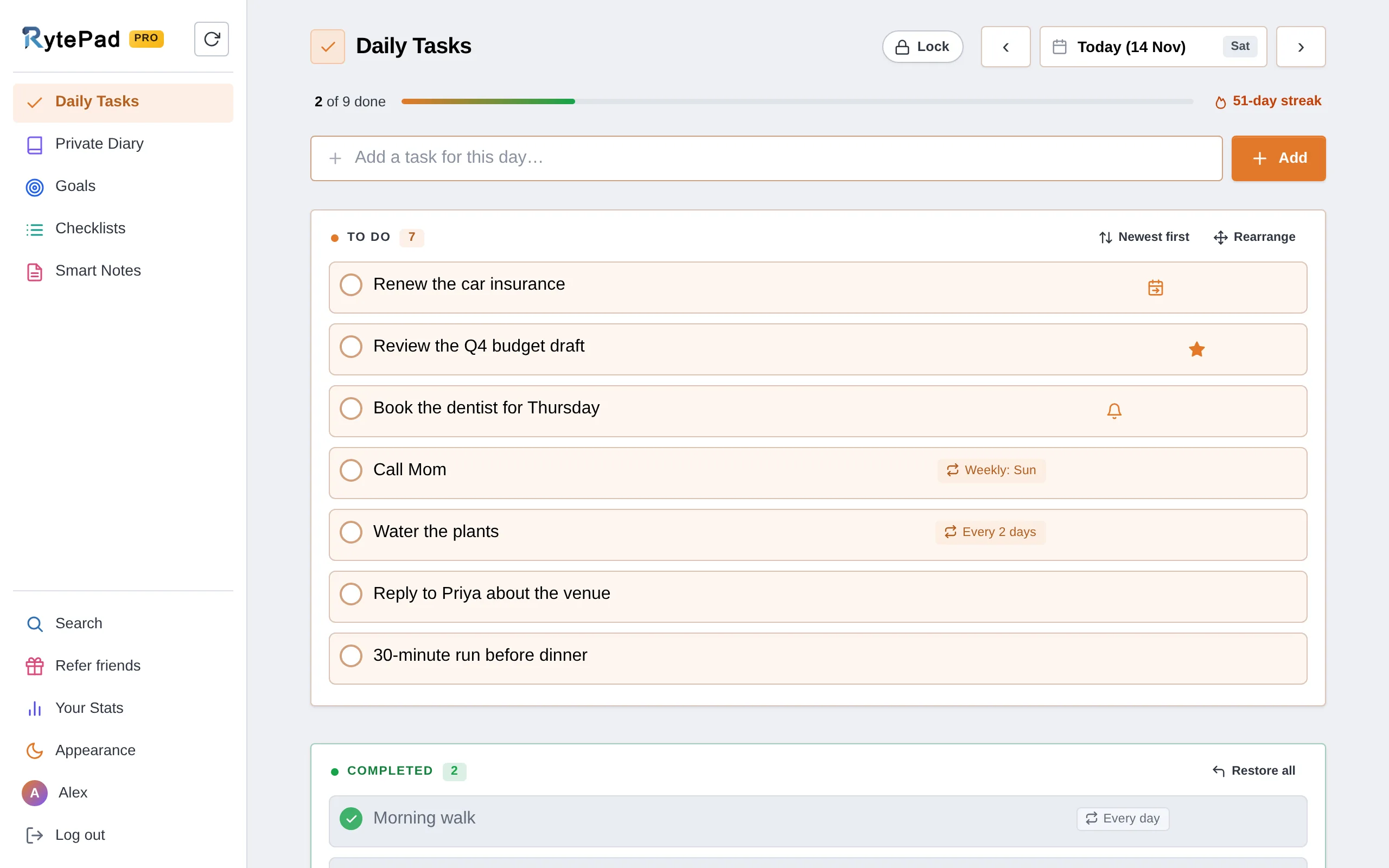
- Daily Tasks for the today list. Every date has its own to-do list, so you can write tomorrow's tonight or plan a few days ahead. A star marks the task that makes the day, Rearrange lets you drag the order, and "4 of 6 done" above the list shows progress. Finished tasks drop into their own box. The free plan allows 25 tasks a day.
- Checklists for the master list. A checklist has no date, so it suits the master list or a shopping list. The free plan has 10 checklists of 25 items each.
- Goals for the big ones. "Learn Spanish" belongs in Goals, not on Monday's list. The free plan holds 40 long-term goals.
- Reminders. An evening summary lists what is still pending today, and a morning summary lists the tasks you planned, at times you choose, as a notification, an email, or both. Both can be switched off.
- Repeating tasks for routines. A task you do every week, such as paying a bill, can repeat on its own: daily, on weekdays, on the days you pick, monthly, yearly or on custom dates. Each day gets its own copy to tick, and the free plan runs 5 repeating tasks at a time.
- Carry-over on Pro. On Pro ($14.97 a year), unfinished tasks carry over to the next day at midnight with a prefix such as D2|: that shows how long they have waited. That makes the three-day rule in step 7 easy to spot.
RytePad will not decide your priorities for you. If you delete a task by mistake, Undo brings it back. The user guide walks through each screen.
A short list for every day
Dated to-do lists, checklists for everything else and a star for what matters. Free, encrypted and on any device.
Three mistakes that keep a list unfinished
Moving yesterday's leftovers onto today unread is how lists grow out of control. Decide on each one. Bullet journaling builds this check into a monthly step called migration.
Email is a list of other people's priorities. Write your list first, then add only the messages that really need action today.
A list of ten small jobs feels productive and leaves the important one untouched. Put the marked task first, and do it before the small ones. If you cannot tell which task matters most, the Eisenhower Matrix sorts them by urgent and important.
To-do lists: your questions answered
How many items should be on a daily to-do list?
As many as you finished on a normal day recently. Your own record is a better guide than any fixed number. Research on the planning fallacy shows people tend to underestimate how long their own tasks take, so a list built on past days is more realistic than one built on hope.
Should I write my to-do list in the morning or the night before?
Either works. Writing it the evening before means you start the day knowing what to do first, and in a 2018 sleep-lab study, young adults who wrote a specific to-do list for five minutes at bedtime fell asleep faster than those who wrote about tasks they had already completed. If your mornings are calm, writing it then is fine too.
What is the difference between a to-do list and a master list?
A to-do list is for one day and stays short. A master list holds everything else: projects, errands and ideas with no date yet. Each day you move a few items from the master list onto the day's list.
What should I do with tasks I keep postponing?
Ask why. A task that moves three days in a row is usually too big, too vague or not important. Break it into its next step, rewrite it with a verb and a detail, give it a time and a place, or delete it.
The bottom line
A to-do list you finish is short, specific and honest about how much a day holds. Keep everything else on a master list, start each item with a verb, shrink projects to their next step and give the hardest task a time. Size the list by what you really got done last week, and close each day with a decision about what is left.
Write tomorrow's list tonight.
One list for every date, checklists for everything else and a star for what matters, in RytePad. Free, private and on any device.
Try RytePad free →Free plan with no time limit · No card · Works in any browserSources
- Buehler, R., Griffin, D. & Ross, M. (1994). Exploring the "planning fallacy": Why people underestimate their task completion times. Journal of Personality and Social Psychology, 67(3), 366–381. doi:10.1037/0022-3514.67.3.366
- Masicampo, E. J. & Baumeister, R. F. (2011). Consider it done! Plan making can eliminate the cognitive effects of unfulfilled goals. Journal of Personality and Social Psychology, 101(4), 667–683. doi:10.1037/a0024192
- Gollwitzer, P. M. & Sheeran, P. (2006). Implementation intentions and goal achievement: A meta-analysis of effects and processes. Advances in Experimental Social Psychology, 38, 69–119. doi:10.1016/S0065-2601(06)38002-1
- Scullin, M. K., Krueger, M. L., Ballard, H. K., Pruett, N. & Bliwise, D. L. (2018). The effects of bedtime writing on difficulty falling asleep: A polysomnographic study comparing to-do lists and completed activity lists. Journal of Experimental Psychology: General, 147(1), 139–146. doi:10.1037/xge0000374
- Kruger, J. & Evans, M. (2004). If you don't want to be late, enumerate: Unpacking reduces the planning fallacy. Journal of Experimental Social Psychology, 40(5), 586–598. doi:10.1016/j.jesp.2003.11.001