
Write Tomorrow's To-Do List Before Bed: What a Sleep Study Found
If your mind starts listing tomorrow's jobs the moment your head hits the pillow, you are in good company. One sleep-lab study suggests the fix takes five minutes and a pen: get the list out of your head before you turn off the light.
Probably, yes. In a 2018 study at Baylor University's sleep lab, 57 young adults wrote for five minutes before lights-out. Those who wrote a to-do list for the coming days fell asleep about nine minutes faster than those who wrote about tasks they had already finished, and the more specific the list, the faster they fell asleep. Keep the list short and concrete, and leave it where you will see it in the morning.
 By RytePad StaffPublished
Most sleep advice is about what to stop doing: no coffee after lunch, no phone in bed, no late workouts. This tip is about something to start, and it is small enough to try tonight. Below is what the research found, why it seems to work, and a five-minute routine you can copy as it is.
- Writing a specific to-do list for five minutes before bed helped people fall asleep faster in a sleep-lab study.
- Specific beats vague: "Email Priya the two venue options" settles the mind more than "Priya".
- A plan for an unfinished task quiets the mental replay, even though the task is still undone.
- Keep it to tomorrow's few real tasks and park the rest on later dates.
- If poor sleep lasts for weeks, talk to a doctor: a list is a habit, not a treatment.
What the sleep study found
In 2018, psychologists from Baylor University and Emory University published a study in the Journal of Experimental Psychology: General with a simple question at its heart: does what you write at bedtime change how quickly you fall asleep?
Fifty-seven healthy adults aged 18 to 30 spent a night in a sleep laboratory, wired up for polysomnography, the same overnight recording sleep clinics use. Before lights-out, everyone wrote for five minutes. Half listed the tasks they needed to remember over the next few days. The other half wrote about tasks they had completed over the previous few days.
The to-do list group fell asleep significantly faster. Baylor's write-up of the study puts the difference at about nine minutes on average. Within that group, people who wrote more specific lists fell asleep faster still. Writing about finished tasks showed the opposite trend: the more detail people wrote, the slower they dropped off.
Michael Scullin, who led the study, noted that a gap of that size is in the range reported in clinical trials of some prescription sleep medications. That comparison is about the size of the effect. It is not a reason to swap a prescription for a notepad.
Keep it in proportion. This was one night, in a lab, with 57 healthy young adults. It is good evidence for a cheap habit, not proof that a list fixes insomnia. More on that below.
Why writing it down quiets your mind
Psychologists have known for nearly a century that unfinished tasks stick in the mind. It is known as the Zeigarnik effect, after Bluma Zeigarnik, whose experiments in the 1920s found that people remembered interrupted tasks better than completed ones. Handy at 11 in the morning. Less handy at 11 at night.
In 2011, E. J. Masicampo and Roy Baumeister looked at what it takes to switch that replay off. Across several experiments, unfinished goals caused intrusive thoughts during an unrelated reading task and dragged down performance on word puzzles. When people were allowed to write a specific plan for the unfinished goal, those effects went away, even though the goal itself was still unfinished.
Their explanation is the useful part: once a plan exists, the mind stops pushing the goal and picks it up again at the time you planned. A bedtime to-do list is exactly that kind of plan. You are not doing tomorrow's work at night. You are telling your brain where the work will be waiting.
The five-minute bedtime list
Five steps, about five minutes in total, which is also the time the study used.
Pick a fixed moment
Attach the list to something you already do every night: after you brush your teeth, or just before you plug in your phone. Doing it at the same point each evening stops it from becoming a nightly debate.
Empty your head first (one minute)
Write down everything that is nagging you, in any order: calls, emails, the electricity bill, the thing you meant to say in the meeting. Don't sort anything yet. Getting it out of your head is the whole point of this minute.
Make every task specific
This is the part the study rewarded. Turn each item into a verb, an object and a detail: not "Priya" but "Email Priya the two venue options"; not "car" but "Book the car service for Thursday morning". A specific item is a finished thought. A vague one keeps your brain working on it after the light goes off.
Choose tomorrow's few, park the rest
Most days only have room for three to five real tasks around everything else that happens. Put those on tomorrow and mark the one that would make the day a success. Everything else goes on a later date or a someday list, so it is written down without being tomorrow's problem.
Leave it where morning-you will look
A sheet of paper on top of your keys works. So does a list that is already sitting on tomorrow's date in an app. Then close the notebook or the app and stop: planning the whole week at midnight defeats the purpose.
A sample bedtime list
Tomorrow, Tuesday
- ★ Send Meera the October invoice (before 10 am)
- Call the dentist to move Thursday's appointment
- Buy a birthday card for Dad on the way home
- Twenty-minute walk at lunch
Parked for later: renew the passport (Saturday), ask Sam about the trip (Friday).
Paper or app?
Both work. The study used pen and paper, and paper has one clear advantage: no screen. If you would rather use your phone, keep the session short, turn the brightness down or switch to dark mode, and close the app when the list is done instead of drifting into email.
Whatever you use, two things matter more than the tool: the list has a date at the top, and it lives in the place you look first in the morning.
How it works in RytePad
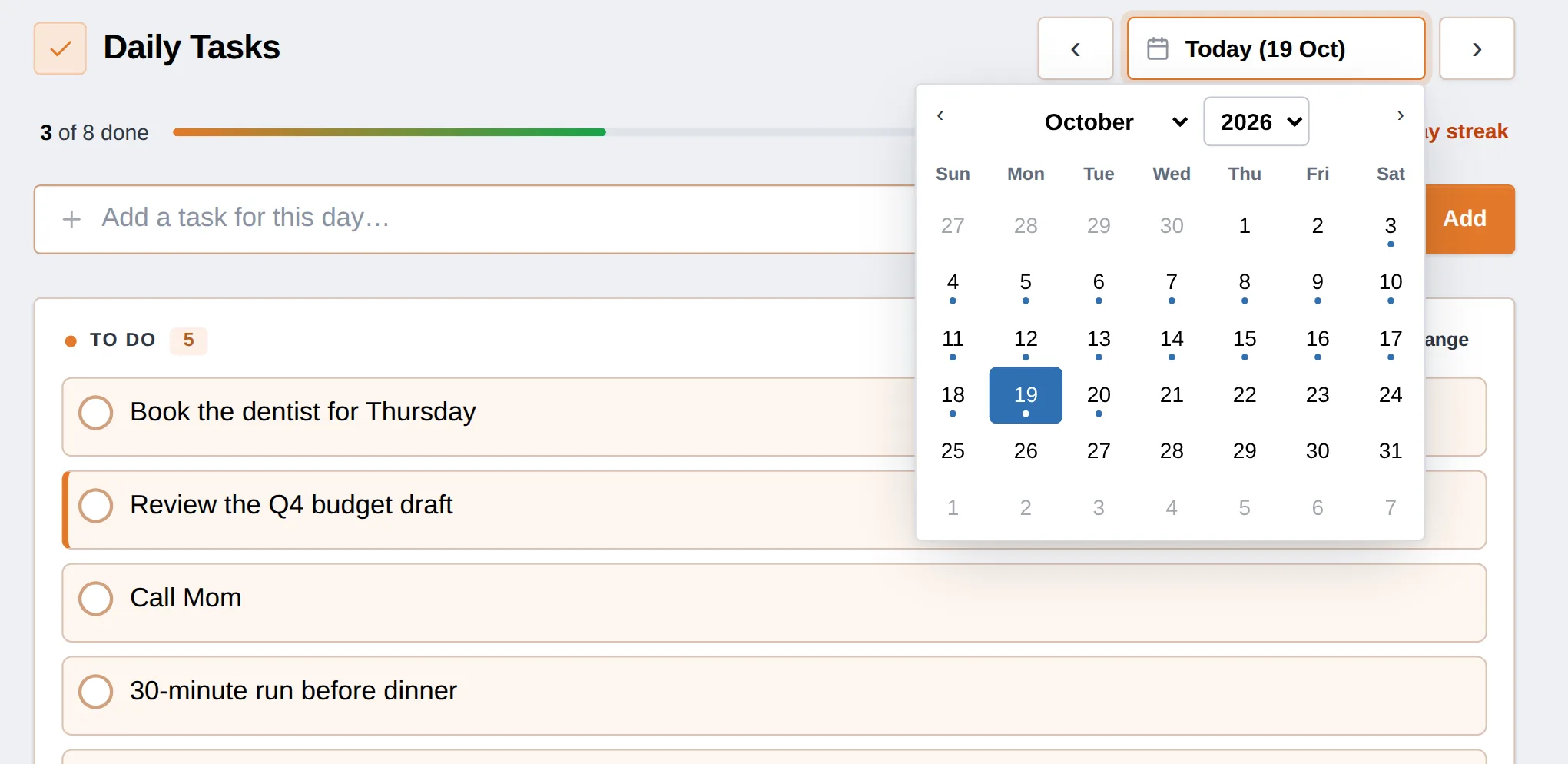
In RytePad's Daily Tasks, every date has its own list, so writing tomorrow's tasks means moving to tomorrow (the arrow next to the date, or the calendar) and typing them in. A star gives the one that matters a coloured edge. If the morning reminder is switched on, RytePad emails you at 6:30 am, in your time zone, on the day of tasks you planned ahead, and dark mode keeps a late session easy on the eyes. The daily planner page shows the whole routine.
Plan tomorrow tonight, free
A list for every date, a star for what matters and an optional 6:30 am reminder, on any device. No card needed.
Four ways the bedtime list goes wrong
Five minutes, then stop. Reorganising the whole month at midnight is how a calming habit turns into a stressful one.
"Work stuff" gives your brain nothing to set down. Write the next physical action instead.
If everything is starred, nothing is. Pick one task that would make tomorrow a good day.
One new message can add three tasks and an hour of thinking. Write the list from your head, not from your inbox.
When a list is not enough
A to-do list helps when tomorrow's tasks are what keep you awake. It will not fix sleep problems with other causes, from pain or late caffeine to anxiety, low mood or sleep apnoea.
If you regularly struggle to fall asleep or stay asleep for weeks at a time, see a doctor. For chronic insomnia, the American College of Physicians recommends cognitive behavioural therapy for insomnia (CBT-I) as the first treatment to try, ahead of medication.
Bedtime to-do lists: your questions answered
Does writing a to-do list before bed help you sleep?
It can. In a 2018 sleep-lab study, young adults who wrote a to-do list for five minutes before bed fell asleep faster, about nine minutes on average, than those who wrote about tasks they had already completed. More specific lists were linked with falling asleep faster.
How long should a bedtime to-do list be?
Short enough to write in about five minutes, the time used in the study. In practice that means a quick brain dump, then three to five specific tasks for tomorrow, with everything else moved to later dates.
Is it better to write it on paper or on my phone?
The study used paper, which avoids a bright screen and the pull of new messages. A phone works too if you keep it brief and close the app afterwards. What matters most is that the list is specific and easy to find in the morning.
What if I remember something after I turn off the light?
Write one line and stop. The aim is to park the thought, not to plan it, so keep a pen and paper or your list app within reach.
Should I write a to-do list or a journal entry about my day?
For falling asleep, the study favoured the to-do list: writing about completed tasks did not help in the same way. Journaling has its own benefits, so if you like both, write your reflection earlier in the evening and finish with tomorrow's list.
Can a to-do list cure insomnia?
No. It is a simple habit that may help when racing thoughts about tomorrow keep you up. Persistent sleep problems deserve a conversation with a doctor; cognitive behavioural therapy for insomnia (CBT-I) is the recommended first treatment for chronic insomnia.
The bottom line
Five minutes, a specific list, tomorrow's date at the top. Get the tasks out of your head before the light goes off, choose the one that matters and park the rest. One small study is not a promise, but this is one of the cheapest experiments you can run on your own sleep.
Tonight: five minutes, one list
Plan tomorrow in RytePad: a list for every date, a star for what matters and an optional morning reminder. Free, private and on any device.
Try RytePad free →Free plan with no time limit · No card · Works in any browserSources
- Scullin, M. K., Krueger, M. L., Ballard, H. K., Pruett, N. & Bliwise, D. L. (2018). The effects of bedtime writing on difficulty falling asleep: A polysomnographic study comparing to-do lists and completed activity lists. Journal of Experimental Psychology: General, 147(1), 139–146. doi:10.1037/xge0000374
- Baylor University (2018). Trouble falling asleep? Baylor prof's research identifies a simple trick that can help. Baylor Proud.
- Masicampo, E. J. & Baumeister, R. F. (2011). Consider it done! Plan making can eliminate the cognitive effects of unfulfilled goals. Journal of Personality and Social Psychology, 101(4), 667–683. doi:10.1037/a0024192
- Qaseem, A. et al. (2016). Management of chronic insomnia disorder in adults: A clinical practice guideline from the American College of Physicians. Annals of Internal Medicine, 165(2), 125–133. doi:10.7326/M15-2175