
How Long Does It Take to Form a Habit? What the Research Actually Says
Twenty-one days is the number everyone quotes. It comes from a 1960 self-help book about plastic surgery patients, not from research on habits. Here is what the studies show, and how to use it when you start something new.
There is no single number. In the best-known study, from University College London, the median time for a new daily habit to become as automatic as it was going to get was 66 days, and individual times ranged from 18 to 254 days. A 2024 review of 20 studies found typical medians of 59 to 66 days, and a 2023 study of more than 30,000 gym members found exercise took months while handwashing at work took weeks. Simple daily habits tied to a fixed cue form fastest, and missing one day does not undo your progress.
 By RytePad StaffPublished

If you have ever started a habit on the first of the month and quietly dropped it by the twenty-second, the 21-day promise may be part of the problem. Expecting a routine to feel easy after three weeks makes week four feel like failure. The research tells a slower, more forgiving story, and it is a more useful one.
- The 21-day figure traces back to a 1960 book about adjusting to plastic surgery, not to habit research.
- In a UCL study the median was 66 days, but individual times ranged from 18 to 254 days.
- Simpler habits form faster: a glass of water after breakfast beats 50 sit-ups.
- Missing one day did not derail habit formation. Long gaps were a different story.
- Plan on about ten weeks for a simple daily habit, and months for complex ones like exercise.
Where the 21-day idea came from
In 1960, a plastic surgeon named Maxwell Maltz published Psycho-Cybernetics, a self-help book about self-image. In its preface he wrote that it usually takes a minimum of about 21 days to see a change in a person's mental image, with examples such as patients getting used to a new face after surgery.
That is an observation about getting used to a change, and Maltz said "a minimum". Over the following decades it was simplified into "21 days to form a habit", a phrase with no study behind it. Researchers at University College London have traced the figure back to Maltz and called it unfounded as a basis for habit formation.
The study behind 66 days
The research most often quoted on this question comes from Phillippa Lally and colleagues at University College London, published in the European Journal of Social Psychology.
They asked 96 volunteers to pick one eating, drinking or exercise behaviour and do it once a day in the same context, for example "after breakfast", for 12 weeks. Choices included eating a piece of fruit with lunch, a 15-minute run before dinner and 50 sit-ups after morning coffee. Every day, participants recorded whether they had done it and rated how automatic it felt, using statements such as "I do it without thinking".
Automaticity rose quickly at first and then levelled off, like most learning curves. For the people whose data fitted that curve well, the median time to reach 95% of their personal plateau was 66 days. The spread was the more interesting result: from 18 days for the fastest to a projected 254 days for the slowest, well beyond the 12 weeks of the study.
What "formed" means here. The study did not look for the day a habit "clicks". It measured how long it took for the behaviour to feel about as automatic as it was ever going to feel: the point where doing it no longer takes a decision.
Two details matter for anyone starting a habit. Simple behaviours became automatic faster than demanding ones: drinking a glass of water levelled off sooner than 50 sit-ups. And missing a single day did not materially affect the process. People who performed their behaviour more consistently showed a clearer habit curve.
What bigger studies found since
Gym visits take months, handwashing takes weeks
In 2023, researchers from Caltech, the University of Chicago and the University of Pennsylvania applied machine learning to two very large data sets: more than 12 million gym check-ins from over 30,000 members of a US gym chain, and more than 40 million handwashing records from over 3,000 hospital workers. They treated a habit as formed once someone's behaviour became highly predictable from its context.
Their headline finding, published in PNAS: going to the gym typically took months to become a habit, about six months on average according to Caltech's summary, while handwashing in the hospital became habitual within weeks. For most gym-goers, the time since their last visit mattered most, and a longer gap made the next visit less likely. Most were also more likely to go on the same days of the week. The time of day made no difference.
A 2024 review: about two months is typical, the range is huge
A systematic review from the University of South Australia, published in Healthcare in 2024, pooled 20 studies with 2,601 participants. Four of them reported how long habits took to form: median times of 59 to 66 days, mean times of 106 to 154 days, and individual results anywhere from 4 to 335 days. The gap between median and mean tells you something on its own: a few slow cases pull the average up, while most people land closer to two months.
The habits that grew strongest were those done often, those people chose for themselves and, in general, those done in the morning.
Why some habits take longer than others
- Complexity. A glass of water after breakfast is one step. A run is a dozen small decisions about clothes, route, weather and energy. The more steps, the longer the road.
- Frequency. Daily repetition gives more practice than three times a week. Weekly habits can still form; they simply get fewer chances to.
- A stable cue. Habits attach to context: a place, a time, the thing you did just before. "Whenever I get a moment" gives a habit nothing to attach to.
- Choice. Habits people picked for themselves tended to grow stronger than ones that were assigned to them.
- Gaps. One missed day is noise. In the gym data, the length of the gap since the last visit was the biggest warning sign.
How to use this when you start a habit
Five steps, drawn from the studies above and from the advice UCL's researchers give patients.
Plan for ten weeks, not three
Expect the first month to need effort and plan to keep going well past it. In a guide for patients, UCL's habit researchers suggest that a simple daily action done in the same place at the same time should feel automatic within about ten weeks. Put the end date in your calendar now, so week four is a milestone rather than a verdict.
Start smaller than feels useful
Two minutes of reading, one push-up, one line in a journal. You can do more on good days. The habit itself is built on the bad days, when the small version is all you have in you.
Tie it to a cue you meet every day
Use the same structure as the UCL volunteers: "After [something I already do], I will [new habit]". After I pour my morning coffee, I will write one line. After I park the car, I will take the stairs. Keep the cue the same until the habit runs on its own.
Keep a simple record
A tick a day is enough. UCL's patient guide includes a ten-week tick sheet and suggests rating once a week how automatic the habit feels, so you can watch it get easier. That weekly rating is the honest measure of progress, more than the length of the streak.
Never miss twice
Missing a day did not derail anyone in the UCL study, while long gaps were the clearest warning sign in the gym data. So treat one miss as normal and make the next day the one you protect. It is the same rule we recommend in our guide to starting a daily journal.
Tracking a habit in RytePad
RytePad is not a dedicated habit tracker: there are no repeating tasks yet and no habit charts. It does have three things that help a new routine stay visible:
- A day streak in Daily Tasks. The progress line above your list counts the days in a row on which you completed at least one task. Add the habit as a task on the days you plan to do it, and it becomes part of a chain you can see. Free on every plan.
- A writing streak in the Diary. If your habit is journaling, the diary counts the days in a row with an entry and shows your recent days as dots.
- Monthly goals. On Pro, set a goal for the month, such as "Walk 20 minutes on 20 days in November", in the goal tracker. The month picker shows an orange dot while a month still has goals to do and a blue one once they are all achieved.
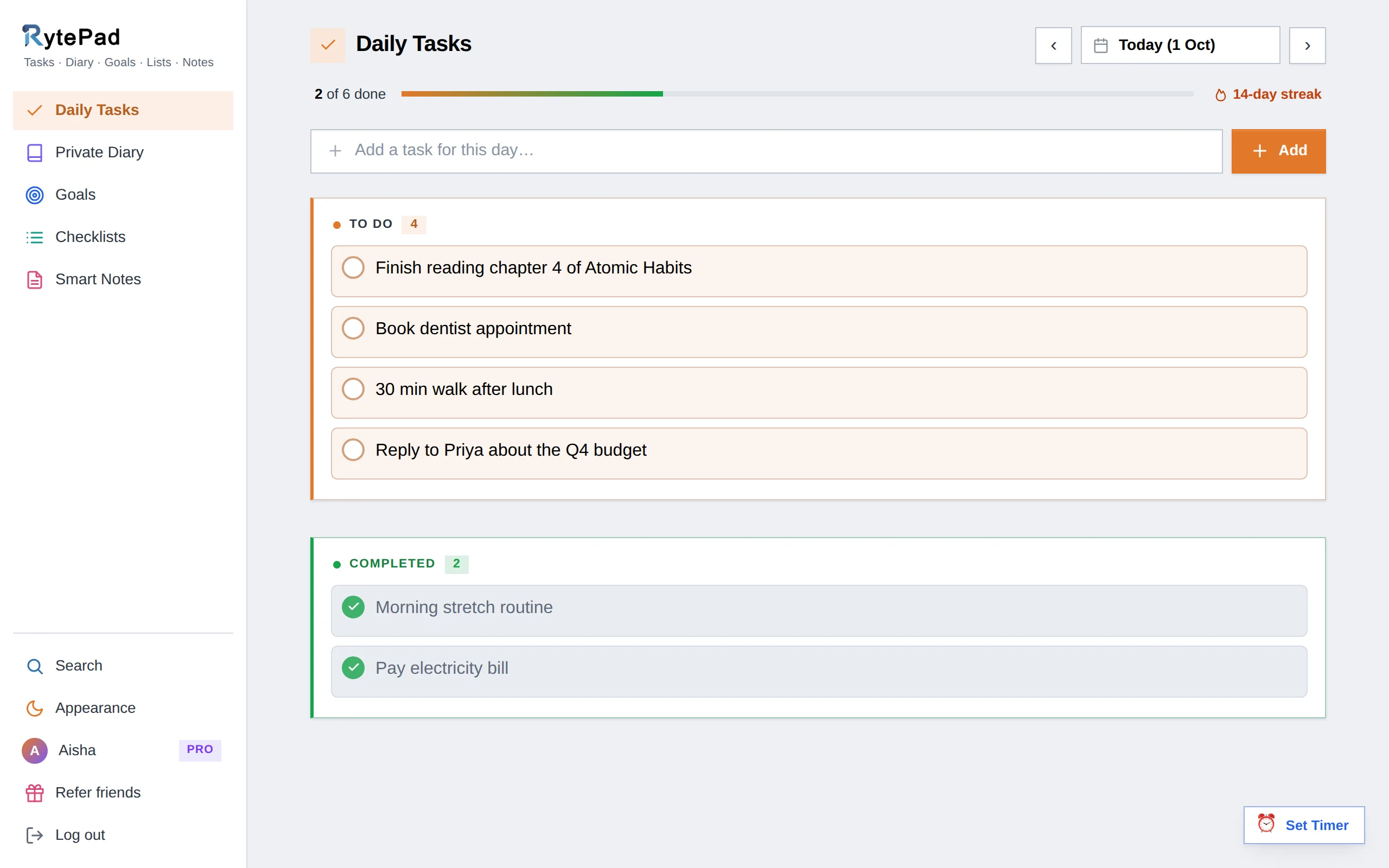
Keep the chain where you can see it
Tasks with a day streak, a diary with a writing streak, goals by the month. Free, encrypted and on any device.
Four mistakes that stall a new habit
Motivation gets a habit started; the cue keeps it going. Decide the when and where in advance, so there is nothing left to decide in the moment.
Every new habit competes for the same attention. Build one until it runs on its own, then add the next.
Morning one day, lunchtime the next, and the habit never gets a home. Keep the cue fixed for the first ten weeks.
All-or-nothing thinking ends more habits than missed days do. One miss is noise; two in a row is the pattern to avoid.
Habit formation: your questions answered
Does it really take 21 days to form a habit?
No study supports 21 days. The figure goes back to a 1960 self-help book by Maxwell Maltz, who wrote that people need a minimum of about 21 days to adjust to a change such as a new face after surgery. Research on habits points to around two months as typical, with wide variation.
Is it 66 days to form a habit?
66 days is the median from one well-known UCL study, in which daily habits took anywhere from 18 to 254 days to reach their peak automaticity. It is a fair rule of thumb for a simple daily habit, not a deadline.
Does missing a day reset a habit?
No. In the UCL study, missing one opportunity did not materially affect the habit formation process. Long gaps are different: in a study of more than 30,000 gym members, the longer the gap since the last visit, the less likely the next one.
Which habits form fastest?
Simple, frequent actions tied to the same cue. In the UCL study, drinking a glass of water became automatic faster than doing 50 sit-ups, and in the 2023 study, handwashing at work became a habit within weeks while gym visits took months.
How do I know when a habit has formed?
When it no longer takes a decision. Researchers measure this with statements such as "I do it automatically" and "I do it without thinking". If you start the behaviour on cue before you have thought about it, it has become a habit.
Should I track my habits?
A simple record helps, especially early on. UCL's patient guide includes a ten-week daily tick sheet and a weekly rating of how automatic the habit feels. Keep tracking light: one tick a day, not a spreadsheet.
The bottom line
Forget 21 days. Plan for about ten weeks of a small, specific action tied to something you already do every day. Expect the first month to take effort, treat a missed day as normal and guard against long gaps. For harder habits like exercise, give it longer: months, not weeks.
Start small. Keep the chain visible.
Plan the days you will do it, tick it off and watch the streak grow in RytePad. Free, private and on any device.
Try RytePad free →Free plan with no time limit · No card · Works in any browserSources
- Maltz, M. (1960). Psycho-Cybernetics. Prentice-Hall.
- Gardner, B. (2012). Busting the 21 days habit formation myth. UCL Research Department of Behavioural Science and Health blog.
- Lally, P., van Jaarsveld, C. H. M., Potts, H. W. W. & Wardle, J. (2010). How are habits formed: Modelling habit formation in the real world. European Journal of Social Psychology, 40(6), 998–1009. doi:10.1002/ejsp.674
- Buyalskaya, A., Ho, H., Milkman, K. L., Li, X., Duckworth, A. L. & Camerer, C. (2023). What can machine learning teach us about habit formation? Evidence from exercise and hygiene. PNAS, 120(17), e2216115120. doi:10.1073/pnas.2216115120
- Caltech (2023). No magic number for time it takes to form habits.
- Singh, B., Murphy, A., Maher, C. & Smith, A. E. (2024). Time to form a habit: A systematic review and meta-analysis of health behaviour habit formation and its determinants. Healthcare, 12(23), 2488. doi:10.3390/healthcare12232488
- Gardner, B., Lally, P. & Wardle, J. (2012). Making health habitual: the psychology of "habit-formation" and general practice. British Journal of General Practice, 62(605), 664–666. doi:10.3399/bjgp12X659466