
How to Start a Daily Journal (and Actually Stick With It)
Most journals die by day four. Not from a lack of discipline, but from starting wrong: too ambitious, too vague, too disconnected from the day. Seven steps that make daily journaling hard to quit.
To start a daily journal that lasts, keep it tiny (two to five minutes), attach it to a habit you already have, answer the same prompt every day, keep the journal where your day already lives, and protect one rule: never miss twice. Reread once a month; that is where journaling pays off.
Regular expressive writing is linked to lower stress, better sleep, clearer thinking and improved mood. None of that matters if the habit does not survive week one. The gap between "I should journal" and "I have journaled for 200 days straight" is not motivation. It is design.
- Start with 2 to 5 minutes a day, not a page count.
- Anchor journaling to a habit you already have (coffee, commute, bedtime).
- Use a fixed prompt so you never face a blank page.
- Keep your journal where your day already lives, next to your tasks and goals.
- Missing a day is fine; missing two in a row is the rule to protect.
The 7 steps
Do them in order. Steps 1 to 4 take ten minutes tonight; steps 5 to 7 shape the next month.
Decide why you are journaling, in one sentence
"To journal more" is not a reason, and vague reasons produce vague habits. Pick one concrete job for your journal: clear your head before bed, process a stressful season, track progress toward a goal, or simply remember your life. Write that sentence as your very first entry.
Your why also decides your format. Head-clearing wants free writing. Goal tracking wants short structured notes. Memory keeping wants a highlight or two per day. All are valid; mixing all three on day one is how journals collapse.
Shrink the habit until it is laughably small
The number one journal killer is ambition. A "500 words every morning" plan feels great on day one and like a debt by day five. Then you skip a day, the debt doubles, and quitting feels like relief.
So start smaller than feels reasonable: two minutes or three sentences, whichever comes first. You can always write more when you feel like it. The goal of month one is not deep insight; it is proving to your brain that this happens every day.
Anchor it to something you already do
Habits do not stick to clock times; they stick to existing routines. Pick a daily anchor and attach journaling right after it: after I pour my morning coffee, after I close my laptop for the day, after I get into bed.
Evening anchors work best for most people, because the day has already happened and there is something to write about. Morning suits planners who like to set intentions. There is no wrong answer, but there must be exactly one anchor. "Whenever I get a moment" means never.
Kill the blank page with a fixed prompt
Staring at an empty page burns willpower you do not need to spend. Choose one default prompt and use it every single day until answering it is automatic.
Reliable starters: What actually happened today? (the reporter). What is taking up space in my head right now? (the unload).
What went well, what did not, what is tomorrow's one priority? (the review). What am I grateful for today? (the classic).
When the fixed prompt gets stale after a month or two, swap it. One prompt at a time, always.
Put your journal where your day already lives
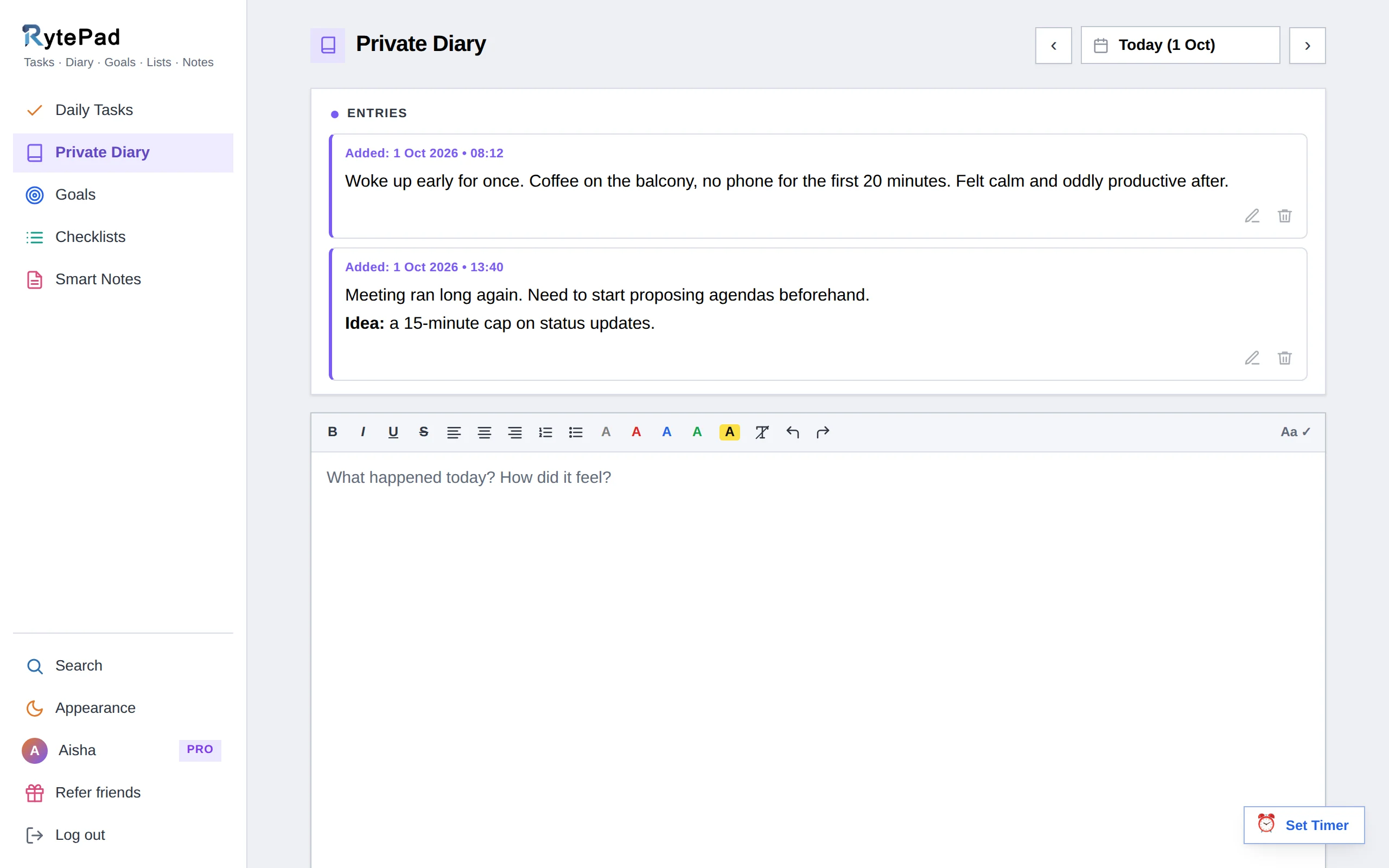
Friction decides habits. If journaling means finding a notebook or opening a separate app you never otherwise touch, every entry starts with an obstacle. The fix is to keep your journal inside the tool you already open daily.
This is exactly how RytePad is built: your private diary sits in the same account as your daily tasks, goals, checklists and notes. You are already there ticking off the day, so the journal is one click away, on every device, with unlimited entries free and AES-256 encryption on every plan.
Start your journal tonight, free
Unlimited private diary entries next to your daily tasks and goals. Encrypted on every plan, no card needed.
Track the streak, but protect the "never twice" rule
Seeing a chain of completed days is real motivation; RytePad's diary calendar marks a dot on every day you wrote, so your streak is visible at a glance. But streaks have a dark side: one missed day can feel like failure, and failure invites quitting.
So adopt the rule serious habit-builders use: missing once is an accident; missing twice is a decision. One gap never matters. The only unbreakable rule is that you write the next day, even if it is a single sentence: "Skipped yesterday. Back today."
Reread monthly: this is where journaling pays
Writing is only half the practice. Once a month, spend ten minutes rereading. You will notice patterns you cannot see day to day: what reliably drains you, what made good weeks good, which worries never came true. This is the moment journaling turns from a diary into a decision-making tool.
Search makes this dramatically easier. In RytePad you can search entries by keyword or date range, so "every entry that mentions work stress this quarter" is one query instead of an hour of page-flipping.
Your first week: the 5-minute template
Copy this structure for days 1 to 7. Total time: about five minutes.
- One line of fact. What happened today, in one sentence.
- One line of feeling. How today actually felt, honestly.
- One line forward. The single thing tomorrow needs to go well.
4 mistakes that kill new journals
Polished entries are performances, and performances are exhausting. Write badly, honestly, for you alone. Encryption exists so nobody else ever grades your prose.
Researching apps, templates and pens for two weeks is procrastination in a productive costume. Pick a tool today and write three sentences.
All-or-nothing thinking ends more journals than boredom does. The chain you are protecting is "never miss twice", not "never miss".
A journal disconnected from your tasks and goals becomes a chore. When it lives beside your daily plan, each entry has obvious material and obvious value.
Which journaling tool should you use?
The habit matters more than the app: pen and paper works, and so do dozens of apps. If you are comparing options, we have reviewed the market in the best online diary apps, the best free journal apps and the best Penzu alternatives.
The short version: pick a tool that is private by default, free to use daily, and close to where you already plan your day. If that sounds like RytePad, that is not an accident; it is what we built it for.
Starting a journal: your questions answered
How long should a daily journal entry be?
As short as three sentences. Consistency beats length: a two-minute daily entry compounds into hundreds of entries a year, while long "ideal" entries usually stop within a week. Write more only when you want to.
Is it better to journal in the morning or at night?
Whichever you will actually do. Evening journaling suits most beginners because the day has already provided material and it doubles as a wind-down ritual. Morning journaling suits planners who use it to set intentions. Pick one anchor and keep it fixed.
What should I write about when nothing happened?
Use your fixed prompt: what is taking up space in your head, one thing you are grateful for, or tomorrow's single priority. "Nothing happened today and I feel flat" is itself a perfectly good entry; patterns in those days are exactly what monthly rereads reveal.
How do I keep my journal private?
Use a tool that encrypts entries rather than just hiding them behind a login. RytePad stores every entry encrypted with AES-256 on every plan, including the free one; Apple Journal and Day One go further with end-to-end encryption. A paper diary is only as private as the drawer it lives in.
Do journaling apps beat pen and paper?
Paper is wonderful for slow reflection, but apps win on the things that keep habits alive: they are always with you, searchable, backed up, and can sit next to your tasks and goals. Many people keep both: an app for the daily habit, paper for occasional deep dives.
How long until journaling becomes a habit?
Research on habit formation suggests anywhere from three weeks to a few months, depending on the person and the size of the habit. This is exactly why step 2 matters: a two-minute habit automates far faster than a thirty-minute one.
The bottom line
Three sentences, tonight, right after something you already do. Same prompt tomorrow. Never miss twice. Reread in a month. That is the whole method, and it is the one that survives week one.
Three sentences. Tonight. That is the whole assignment.
Your diary, tasks, goals and notes in one private, encrypted place. The easiest spot to never miss twice.
Try RytePad free →Free plan with no time limit · No card · Works in any browser