
What Is Bullet Journaling, and How Do You Start?
Bullet journaling turns one plain notebook into a to-do list, a calendar and a diary. Here is how Ryder Carroll's method works, in plain words, and how to set one up tonight with a pen.
Bullet journaling is a paper planning method created by designer Ryder Carroll and shared online in 2013. You write short bulleted lines (tasks, events and notes) into a few simple pages: an index, a future log, a monthly log and daily logs. Once a month you migrate: you review every unfinished task and either rewrite it, schedule it or cross it out.
 By RytePad StaffPublished

What is bullet journaling? Search for it and you will find pages of hand-lettered calendars and watercolour headers. Underneath the art is something much plainer: a way of writing short lines in a notebook so your tasks, plans and notes live in one place and get reviewed on a schedule.
This explainer sets out how the method works, using its creator's own guides, and walks you through a setup. If what you want is a written diary rather than a planner, start with our guide on how to start a daily journal instead.
- Bullet journaling was created by Ryder Carroll, a digital designer, who launched bulletjournal.com on 8 August 2013.
- Everything is written as short lines called rapid logging, marked with a dot for tasks, a circle for events and a dash for notes.
- Four core pages do the organising: the index, the future log, the monthly log and the daily log.
- Migration, a monthly review of unfinished tasks, is the step that keeps your list honest.
- All you need is a notebook and a pen. Drawing and decoration are optional.
What is bullet journaling? A to-do list, planner and diary in one notebook
A bullet journal is a notebook you set up yourself, page by page, instead of buying a planner with the dates already printed. The official site describes the method as a mix of productivity system and mindfulness practice, and its book promises to help you "track the past, order the present, and design the future".
In practice it does three jobs at once:
- A to-do list: tasks for today, this month and the months ahead.
- A calendar: events, appointments and dates you want to remember.
- A log of your days: short notes about what happened and what you thought.
Unlike a printed planner, a busy day can take two pages and a quiet one three lines, so no blank pages go to waste.
Where bullet journaling comes from: Ryder Carroll and a 2013 website
Ryder Carroll built the method for himself. According to the official site, he developed it to help with his attention deficit hyperactivity disorder (ADHD).
He worked as a digital designer for more than a decade. On 8 August 2013 he launched bulletjournal.com with a tutorial video. After mentions on Lifehack.org and Lifehacker the site went viral, and online communities began sharing their own versions.
- 2014: a Kickstarter campaign reached its $10,000 goal in 8 hours and led to an official notebook.
- 2015: an updated video introduced new bullets and the future log.
- 2018: Portfolio/Penguin published his book, The Bullet Journal Method, now in 28 languages.
The method grew in public, which is one reason the official guides keep saying you are free to change it.
Rapid logging: three bullets that sort every line
Rapid logging is the language of the method: each item is one short, factual line with a symbol in front. The official guide to rapid logging, bullets and signifiers uses three core bullets.
| Bullet | Means | Example |
|---|---|---|
| • dot | Task: something to do | • Pick up dry cleaning |
| o circle | Event: something dated, planned or already past | o Charlie's birthday |
| – dash | Note: a fact, idea or observation | – Bakery closes at 4 on Sundays |
Examples for tasks and events are taken from the official guide.
The task dot changes as things happen:
- X: the task is done.
- > (arrow right): migrated, moved forward to the next monthly log or a collection.
- < (arrow left): scheduled, moved into the future log for a later month.
Keep lines short and objective. The guide's example turns "I bought cake at the local bakery today and went home" into "Bought cake and went home." If an event deserves more, log it in one line and write about it at length on the next free page.
Placed to the left of a bullet, these add context:
- * Priority: the tasks that matter most today.
- ! Inspiration: an idea or insight worth keeping.
- Eye symbol, explore: something to look into further.
The four core pages of a bullet journal, plus collections
Rapid logging fills four kinds of page, from the long view down to today.
- Index: the first couple of pages, kept as a table of contents. Number your pages, and each time you start a new section, add its title and page number here.
- Future log: dates and tasks for the months ahead. Two evenly spaced horizontal lines across two facing pages give you six boxes, one per month.
- Monthly log: a two-page spread. On the left, the dates of the month down the side with events beside them. On the right, the tasks you want to get done this month.
- Daily log: today's date at the top, then rapid logging through the day. If you do not fill the page, the next date simply starts where you stopped.
The daily log is where most of the writing happens, and it works best when each task is a clear first action. Our guide on how to write a to-do list you will actually finish covers how to word them.
Collections: pages for one topic
A collection gathers entries on one theme, such as a project or a packing list. Write the topic at the top, add it to the index, and move related entries there.
The official guides list popular ones, including habit trackers, mood trackers, finance logs and gratitude logs. Habit tracking on paper is an old idea: Benjamin Franklin kept a small book of charts for his 13 virtues in the 1700s.
Migration: the monthly review that keeps your list short
Migration is the step people skip, and the one that makes the method work. At the end of each month, before writing the new monthly log, you look back at every task that is still open.
For each one, ask a blunt question: is this still worth my time? Then do one of three things:
- Still matters this month: mark it > and copy it into the new monthly log.
- Matters, but months away: add it to the future log and mark the original <.
- No longer matters: cross it out. That is a decision, not a failure.
Rewriting by hand is the point. A task you have copied out three times either gets done or gets dropped. The official guides also suggest a quick review at the end of each day, and a bigger one when you start a new notebook.
How to start a bullet journal tonight: six steps
The first setup fits into one evening. Keep it plain for the first month, so you learn what you actually use before you add anything.
Get a notebook and a pen
Any notebook you will carry works. The official beginners' guide says you do not need to be an artist, only a notebook, a pen and an idea of what you want.
Write down why you are doing it
The guide suggests thinking about your intentions first. One or two lines is enough, such as "stop forgetting bills". It tells you which collections are worth making later.
Number the pages and make an index
Label the first two pages "Index". Number the pages that follow if your notebook does not do it for you. Every new section gets a line in the index.
Draw a future log
On the next two facing pages, draw two horizontal lines across each to make six boxes, and write a month in each. Add birthdays, renewals and trips you already know about.
Set up this month
Write the month's name on the next spread. List the dates down the left page, and on the right page, list the tasks you expect to work on this month. You do not have to wait for the 1st; start with the month you are in.
Start today's daily log
Write today's date and rapid log as the day goes. A first page might look like this:
- * • Pay the electricity bill
- X Book dentist appointment
- o Team meeting moved to 3pm
- – Sam recommends the green notebook brand
- > Sort out the spare room (moved to next month)
Then repeat. At the end of the month, migrate, and set up the next monthly log.
Who bullet journaling suits, and who may find it hard work
The method rewards people who like paper and do not mind a little admin. It is a good fit if you:
- want one place for tasks, dates and notes instead of several apps;
- like reviewing your plans and dropping what no longer matters;
- enjoy writing by hand, or want fewer screens in your day.
It can be a poor fit too. Paper cannot remind you or search, and repeating chores must be copied out by hand. If you skip migration, a bullet journal becomes an ordinary notebook full of open dots. And if decorated spreads online make it feel like a craft project, remember that decoration is optional.
Doing this in RytePad
Paper is the heart of the method. If you would rather keep the same structure on your phone and laptop, RytePad's sections map onto the core pages, and the Diary in our online journal holds longer writing:
- Daily Tasks as the daily log. Each date has its own list, you can plan days ahead from the calendar, and a star marks a task as important, much like the priority signifier. The free plan allows 25 tasks a day.
- Goals as the monthly and future logs. Long-term goals are free (up to 40); monthly goals on their own tab are part of Pro.
- Checklists as collections. Lists that are not tied to a date, such as books to read or a packing list. The free plan has 10 lists of 25 items.
- Repeating tasks for chores that come back. Set a task to repeat weekly, monthly or on dates you pick, and each day it is due gets its own copy, so nothing is copied out by hand. The free plan runs 5 repeating tasks at a time; Pro has no limit.
- Search as the index. One search page covers tasks, diary entries, goals, lists and notes by word, and tasks and diary entries by date range too.
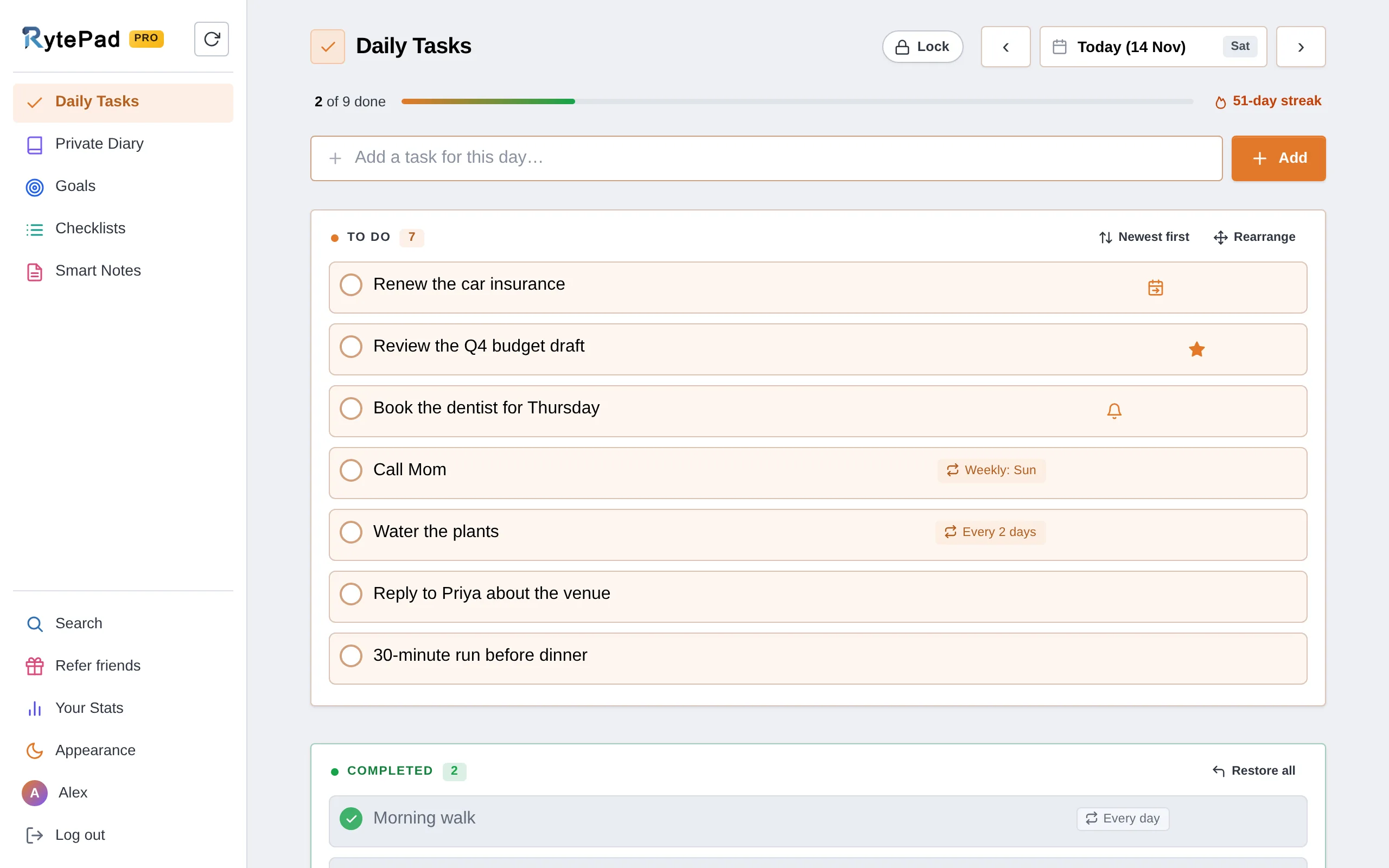
One honest difference: on Pro you can switch on carry-over, which copies unfinished tasks to the next day at midnight, marked D2, D3 and so on. That saves rewriting, but it is not the deliberate review Carroll describes, so set aside a few minutes each month to delete what no longer matters. RytePad has no spreads, templates or drawing tools, and there are no native apps; it runs in any browser.
Your daily log, on every device
A list for each day, goals, checklists and a private Diary, encrypted with AES-256. Free, in any browser.
Bullet journaling: your questions answered
Who created bullet journaling?
Ryder Carroll, a digital designer based in New York, created the method to manage his own tasks and ideas. He shared it on bulletjournal.com in August 2013 and published The Bullet Journal Method in 2018.
Do I need a special notebook for a bullet journal?
No. The official beginners' guide says all you need is a notebook and a pen. Pick one small enough to carry, with pages you can number.
What do the bullet journal symbols mean?
A dot is a task, a circle is an event and a dash is a note. A task marked X is done, a right arrow means it was migrated forward, and a left arrow means it was scheduled into the future log.
Does a bullet journal have to look artistic?
No. Decorated pages are popular online, but the official guides say you do not need to be an artist. A plain list with dates and bullets is a complete bullet journal.
Can you bullet journal digitally?
Yes. The official guide calls the method primarily analogue but says you can use digital tools or skip the notebook entirely. You lose the slow rewriting of migration, so build in a monthly review instead.
The bottom line
Bullet journaling is less about pretty pages than about short lines and regular reviews. Write tasks, events and notes as quick bullets, keep an index, a future log, a monthly log and daily logs, and migrate once a month. Start plain, use it for a month, and only then add the pages you find you need.
Keep today's list where you can find it.
Plan each day, track goals and keep collections in RytePad. Private, encrypted and free on any device.
Try RytePad free →Free plan with no time limit · No card · Works in any browserSources
- Carroll, R. (2018). The Bullet Journal Method: Track the Past, Order the Present, Design the Future. New York: Portfolio/Penguin. ISBN 9780525533337. Book page: bulletjournal.com/pages/book
- Bullet Journal. The Bujo Backstory. bulletjournal.com/pages/story
- Bullet Journal (2023). What is the Bullet Journal Method? bulletjournal.com/blogs/faq/what-is-the-bullet-journal-method
- Bullet Journal (2023). What is Rapid Logging? Understand Rapid Logging, Bullets, and Signifiers. bulletjournal.com/blogs/faq/what-is-rapid-logging-understand-rapid-logging-bullets-and-signifiers
- Bullet Journal. How to Start a Bullet Journal for Beginners, bulletjournal.com/blogs/faq/how-to-start-a-bullet-journal-for-beginners; with How to Make a Future Log, bulletjournal.com/blogs/faq/how-to-make-a-future-log, and How to Write a Daily Log, bulletjournal.com/blogs/faq/how-to-write-a-daily-log