
Gratitude Journal: What the Research Says and How to Start
A gratitude journal is one of the simplest writing habits there is: a few lines about what went right. Here is what the studies found, where the evidence is thin, and a way to start tonight in about ten minutes.
A gratitude journal is a short, regular record of things you are thankful for. In controlled studies, people who kept one reported more positive mood than people who listed hassles or neutral events, but the effects are modest and similar to other positive exercises. Write a few specific items, in some depth, once to three times a week.
 By RytePad StaffPublished
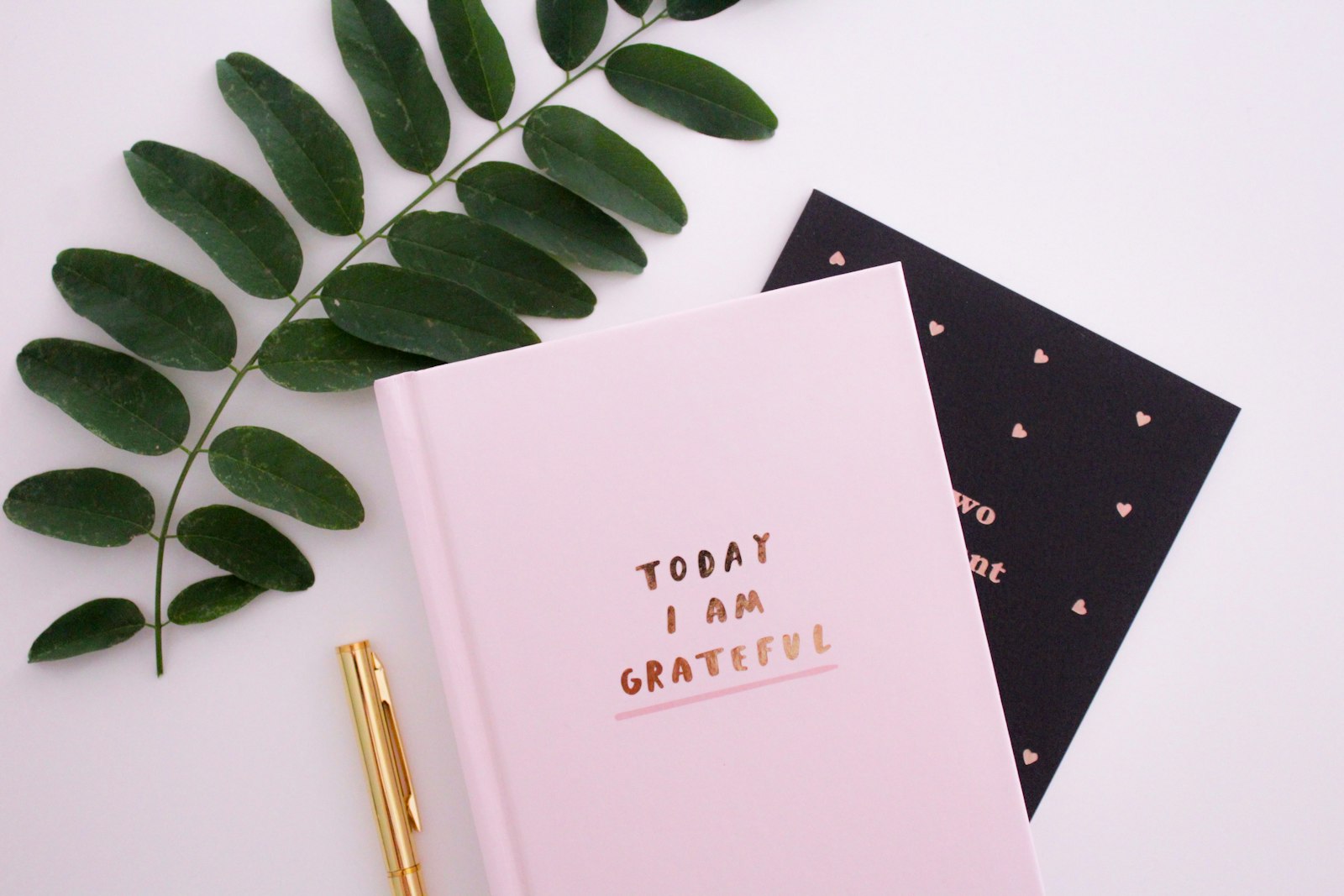
A gratitude journal asks very little: a notebook or a note on your phone, a few minutes, and one question, what went well? That simplicity is why it is one of the most studied writing habits in psychology. It is also why it is easy to start and easy to drop.
This guide sets out what the research shows, including the less flattering results, and turns it into a routine you can keep. If you have never kept any journal before, our guide on how to start a daily journal covers the basics first.
- In experiments published in 2003, people who listed things they were grateful for reported more positive mood than people who listed hassles or neutral events.
- Later reviews found the benefits are real but small, and about the same as other positive exercises.
- Detail matters more than quantity: one specific moment beats five vague ones.
- Writing once or a few times a week may work as well as writing daily, and it stays fresher.
- It is a well-being habit, not a treatment. For depression or anxiety, talk to a professional.
What a gratitude journal is: a few specific good things, written down
A gratitude journal is a notebook, file or app where you regularly write down things you are thankful for. In many studies, people were asked to record five things from the past week, one short sentence each.
The items can be small or large. A hot shower after a cold walk counts. So does a friend who rang at exactly the right moment.
- Not a full diary. It picks out the good parts of a day on purpose.
- Not forced cheerfulness. You can have a rotten week and still notice one thing that helped.
- Not a to-do list. Nothing on it needs doing.
The writing itself matters. Guides from the Greater Good Science Center at UC Berkeley stress putting items on paper or screen instead of only thinking them, because words make a thought more concrete and easier to return to.
What gratitude journal studies found: a modest lift in mood
The best-known experiments come from psychologists Robert Emmons and Michael McCullough, who published three studies on counting blessings in 2003. Volunteers were randomly assigned to list things they were grateful for, list daily hassles, or record neutral events or comparisons with others.
In the first study people kept weekly records, and in the second they wrote daily. The third study involved adults with neuromuscular disease, who were assigned either to the gratitude exercise or to a control group.
Across the three studies, the gratitude groups scored higher on several, though not all, measures of well-being. The most consistent result was more positive mood.
Greater Good's summary of the work adds that people who wrote weekly for 10 weeks, or daily for two weeks, reported more gratitude, more optimism about the future and better sleep than the comparison groups.
A close cousin: three good things
In 2005, Martin Seligman and colleagues ran a randomised online study of five happiness exercises and one placebo exercise. Three of the five raised happiness and lowered depressive symptoms over time.
One of them was three good things: every evening for a week, write down three things that went well and why they happened. According to Greater Good, people who did it were happier a week, a month, three months and six months later.
Where the evidence is weaker: small effects, similar to other habits
Not every study finds big effects. Even Greater Good's editors note that some gratitude journal studies show strong benefits and others very little.
A 2016 meta-analysis led by Don Davis pooled the trials. Gratitude exercises beat doing nothing on psychological well-being, and beat neutral activities by a small margin. Against other psychologically active exercises, they did about as well, not better.
A 2021 meta-analysis by David Cregg and Jennifer Cheavens covered 27 studies and 3,675 people, looking at symptoms of depression and anxiety. The effects were small, and larger when gratitude was compared with a waiting list than with an active exercise. The authors advise people trying to ease these symptoms to choose approaches with stronger evidence.
A gratitude journal is a cheap, pleasant habit that may lift your mood a little. It is not a treatment. If low mood or anxiety is getting in the way of daily life, talk to a doctor or a qualified therapist.
How often to write in a gratitude journal: weekly may beat daily
More is not always better. In research-based tips he gave Greater Good, Emmons recommends writing once or twice a week rather than every day.
He points to a study by Sonja Lyubomirsky and colleagues. People who wrote once a week for six weeks reported a boost in happiness; people who wrote three times a week did not. His explanation is that we get used to good things quickly when we focus on them constantly.
Other advice goes further: Greater Good's own practice page suggests writing at least three times a week for two weeks. The evidence on the ideal rhythm is thin, so choose one you can keep and that still feels fresh.
- Just starting: two or three evenings a week.
- Entries feel repetitive: drop to once a week and write in more depth.
- You enjoy it daily: keep going, and vary what you write about.
Time of day matters less than you might think. Emmons says there is no evidence that morning works better than bedtime. If you already write tomorrow's to-do list before bed, a few gratitude lines fit neatly after it.
How to start a gratitude journal: six steps
These steps turn the research tips into a routine. The first entry takes about ten minutes.
Pick one place to write
A notebook by the bed or a diary app both work. Keep every entry in one place, so the good moments pile up where you can reread them later.
Choose your days and a cue
Pick two or three fixed days and tie the writing to something you already do, such as making tea after dinner or getting into bed.
A steady cue does much of the work. Our look at how long it takes to form a habit explains why repeating the same action in the same context helps it stick.
Write three to five specific items
Name what happened, who was involved and when. "My neighbour took in my parcel on Thursday" gives your memory far more to hold on to than "nice neighbours".
Go deep on one of them
Emmons advises depth over breadth: describing one thing in detail does more than a long, quick list. Take your best item and add two or three sentences on how it felt and why it happened.
Include people, and try subtraction
Gratitude for people tends to have more impact than gratitude for things. Now and then, try subtraction instead of addition: picture your week without that person or event.
- People: who made today easier, and what exactly did they do?
- Subtraction: what would this month have been like without them?
- Surprises: what good thing did you not see coming? Unexpected events tend to stir stronger gratitude.
On days when nothing comes, borrow a question from our list of journal prompts.
Reread after a month
At the end of the first month, read every entry in one sitting. Notice which people and moments keep coming back. If the entries have started to sound the same, write less often and go deeper.
Gratitude journal examples: vague lines vs specific ones
The difference between an entry that works and one that does not is usually detail. Here are four pairs.
Specific: "Dad drove forty minutes on Saturday to fix my bike chain, then stayed for tea and told the story about his first bike."
Specific: "Meena caught the error in my report before it went out. She did it quietly and did not make a thing of it."
Specific: "Twenty minutes of sun on the bench at lunch, the first warm day in weeks. I ate slowly for once."
Subtraction: "If my knee had not healed, I would have missed the walk with Sam on Sunday and the view from the top."
- The bus driver who waited when he saw me running.
- Leftover soup, so no cooking tonight.
- A long call with my sister. She has a way of making a bad week sound funny, and by the end I was laughing about the same things that annoyed me on Monday.
Doing this in RytePad
Paper works well. If you would rather keep your entries private and on every device, the Diary in RytePad's online journal fits a gratitude habit:
- Diary entries for each day. The free plan allows 4 entries a day, and an entry can run to 25,000 characters, so there is room to go deep on one item.
- A writing streak. Recent days show as dots, so you can see your rhythm. If you write two or three times a week, judge yourself by the week, not the streak; Your Stats counts your entries per week.
- Search for the monthly reread. Find old entries by a word, such as a person's name, or by a date range.
- Private by design. Entries are encrypted with AES-256 before they reach the database, and no admin screen shows them. On Pro, a 4-digit PIN can lock the Diary.
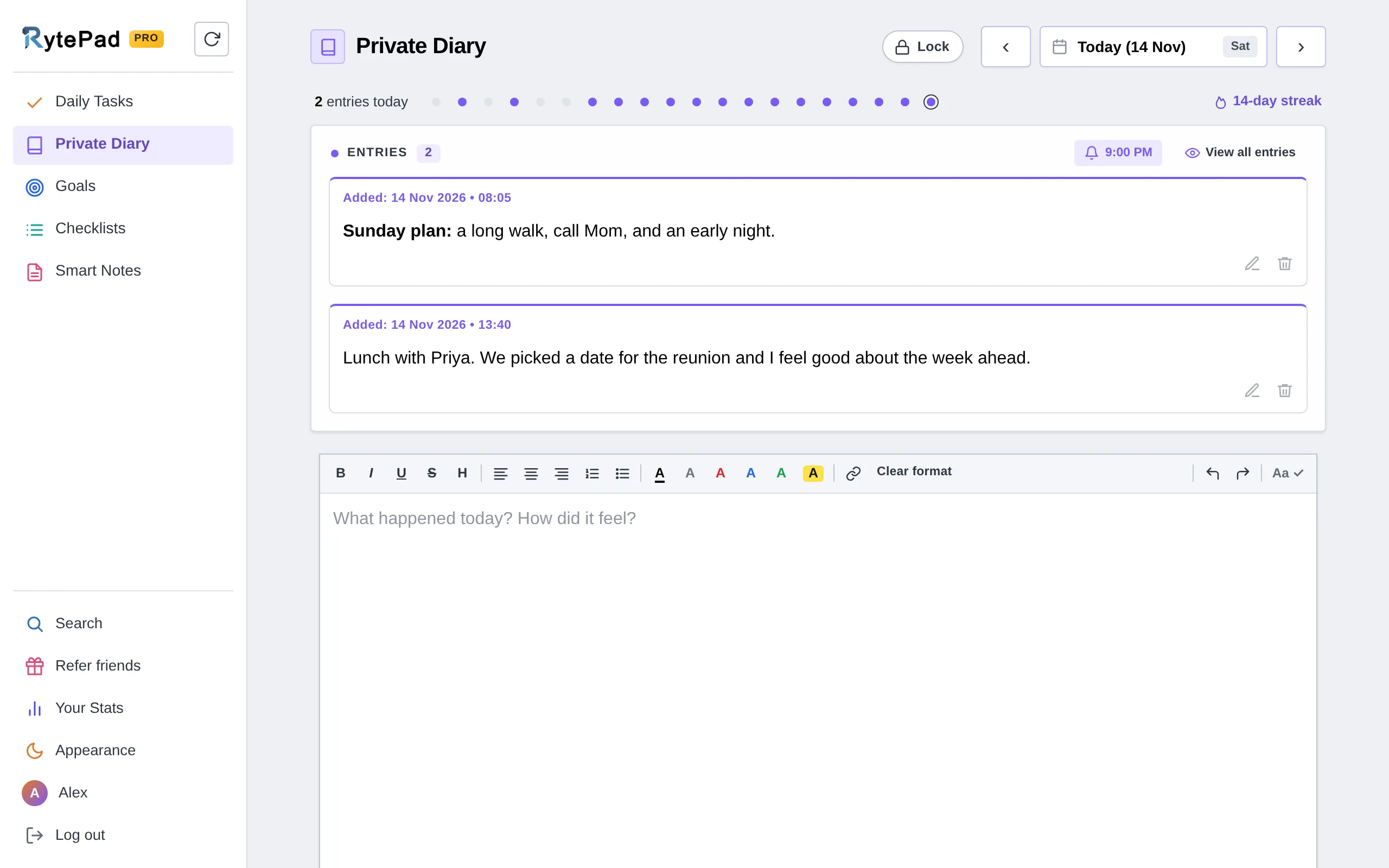
RytePad has no gratitude template, but Remind me in the Diary can nudge you at a time you choose, on days you have not written yet. There are no native apps; it runs in any browser.
A private place for good things
Diary entries encrypted with AES-256, a writing streak and search by word or date. Free, on any device.
Gratitude journal: your questions answered
What should I write in a gratitude journal?
Write three to five specific things from the past day or week that you are thankful for, with a sentence or two on why. People often matter more than objects, and one item described in detail does more than a long, vague list.
How often should you write in a gratitude journal?
There is no fixed rule. Robert Emmons suggests once or twice a week, citing a study in which weekly writers grew happier and people writing three times a week did not. Greater Good's practice guide suggests at least three times a week. Pick a rhythm that stays fresh.
Does gratitude journaling really work?
Controlled studies link it to more positive mood and well-being, but reviews find the effects are small and similar to other positive exercises. It is a useful habit, not a cure.
Is it better to write in the morning or at night?
Emmons says there is no evidence that one time of day works better than another. Choose the time you can keep, and tie it to something you already do.
Can a gratitude journal help with depression or anxiety?
A 2021 meta-analysis of 27 studies found only a small effect on symptoms of depression and anxiety, and its authors recommend approaches with stronger evidence. If symptoms affect your daily life, speak to a doctor or therapist.
The bottom line
A gratitude journal will not change your life overnight, and the research says so. What it can do is give you a small, reliable lift and a record of good moments you would otherwise forget. Write a few specific lines, two or three times a week, go deep on one, and reread them at the end of the month.
Write down what went right.
Keep your gratitude journal in RytePad's private, encrypted Diary. Free, and on any device.
Try RytePad free →Free plan with no time limit · No card · Works in any browserSources
- Emmons, R. A., & McCullough, M. E. (2003). Counting blessings versus burdens: An experimental investigation of gratitude and subjective well-being in daily life. Journal of Personality and Social Psychology, 84(2), 377–389. doi.org/10.1037/0022-3514.84.2.377
- Seligman, M. E. P., Steen, T. A., Park, N., & Peterson, C. (2005). Positive psychology progress: Empirical validation of interventions. American Psychologist, 60(5), 410–421. doi.org/10.1037/0003-066X.60.5.410
- Davis, D. E., Choe, E., Meyers, J., Wade, N., Varjas, K., Gifford, A., Quinn, A., Hook, J. N., Van Tongeren, D. R., Griffin, B. J., & Worthington, E. L. (2016). Thankful for the little things: A meta-analysis of gratitude interventions. Journal of Counseling Psychology, 63(1), 20–31. doi.org/10.1037/cou0000107
- Cregg, D. R., & Cheavens, J. S. (2021). Gratitude interventions: Effective self-help? A meta-analysis of the impact on symptoms of depression and anxiety. Journal of Happiness Studies, 22, 413–445. doi.org/10.1007/s10902-020-00236-6
- Greater Good Science Center, University of California, Berkeley. Marsh, J. (2011), Tips for Keeping a Gratitude Journal, greatergood.berkeley.edu/article/item/tips_for_keeping_a_gratitude_journal; and the Greater Good in Action practices Gratitude Journal, ggia.berkeley.edu/practice/gratitude_journal, and Three Good Things, ggia.berkeley.edu/practice/three-good-things