
End-of-Year Reflection Questions: 50 Prompts to Close the Year
Fifty end-of-year reflection questions in eight groups, a five-question version for busy evenings, and a simple way to turn your answers into plans for next year.
Good end-of-year reflection questions cover four things: what happened, what went well, what was hard, and what you want next. Pick the groups that fit your year, write short answers, and finish with two or three goals for next year. Research on New Year's resolutions suggests goals worded as something to work towards tend to last better than goals about stopping something.
 By RytePad StaffPublished

December fills up fast, and the year often ends before you have looked back at it. These end-of-year reflection questions give you a way to do that in one quiet evening, or in a few short sittings spread over the last weeks of the year.
There are 50 questions in eight groups, from the moments you want to remember to the plans you want to make. You do not need to answer all of them. For everyday questions the rest of the year, our list of 110 journal prompts covers mornings, evenings, gratitude and more.
- A good year-end review looks back first (what happened, what went well, what was hard) and plans second.
- Pick two or three groups that fit your year. Short, honest answers beat long, polished ones.
- A 2014 study found people start on goals more often after "fresh start" dates such as a new year.
- A 2020 study of New Year's resolutions found goals worded as something to work towards were kept more often than goals about avoiding something.
50 end-of-year reflection questions, in eight groups
Start with the group that pulls at you. Each question stands on its own, so skipping is fine.
Looking back at the year
Start with the facts. A quick scroll through your photos, calendar or diary helps with these.
- 1. What are three words that describe this year?
- 2. What did a normal week look like in January, and what does it look like now?
- 3. Which month felt the longest, and which flew by?
- 4. What were the five biggest things that happened to me this year?
- 5. Where did I go, and which place do I still think about?
- 6. What did I start this year that I had never done before?
- 7. Which day would I happily live again?Example: the first warm Saturday at the lake, not the day of the big event.
- 8. If this year were a chapter in a book, what would its title be?
Wins and proud moments
Small wins count: a finished course and a fixed shelf both belong here.
- 9. What am I most proud of from this year?
- 10. What did I finish, even if it took longer than I hoped?
- 11. Which goal did I reach, and what helped most?
- 12. When did I surprise myself?
- 13. What compliment or thank-you from this year has stayed with me?
- 14. What am I grateful for that I did not have a year ago?
A short gratitude habit can carry question 14 into the new year. Our guide to keeping a gratitude journal covers what the research found and how to start.
Hard parts and lessons
Be kind to yourself here. The aim is a useful lesson, not a list of mistakes.
- 15. What was the hardest part of this year?
- 16. What got me through it?
- 17. What did I worry about that never happened?
- 18. Which decision would I make differently, knowing what I know now?
- 19. What did I keep putting off, and why?
- 20. What is the most useful lesson this year taught me?
People and relationships
- 21. Who made this year better, and do they know it?
- 22. Who did I get closer to?
- 23. Who do I miss, and could I reach out?
- 24. Which conversation changed how I think about something?
- 25. How did I show up for the people I care about?
- 26. Which relationship needs more of my time next year?
Habits, health and time
- 27. Which habit did I build this year, and which one slipped?
- 28. What gave me energy, and what drained it?
- 29. Where did my time go that I did not plan for?
- 30. What did I do just for fun?
- 31. How did I rest, and was it enough?
- 32. What one small change made my days easier?
Work, money and learning
- 33. What part of my work did I enjoy most?
- 34. What skill did I get better at?
- 35. What did I learn outside work, from a book, a course or a person?
- 36. What money decision am I glad I made?
- 37. What would I like to understand better by this time next year?
- 38. What is one thing I could stop doing at work without anyone missing it?
Letting go
These questions clear space before you plan. Answer them, then close the page.
- 39. What am I ready to leave behind in this year?
- 40. Which expectation of myself was unfair?
- 41. What can I forgive, in myself or someone else?
- 42. Which plan no longer fits, and can I drop it without guilt?
- 43. What clutter, in my home or my calendar, is worth clearing before January?
Looking ahead to next year
- 44. How do I want to feel at the end of next year?
- 45. What one word or theme do I want for next year?
- 46. What are two or three things I want to work towards?
- 47. What is the first small step for each one, and when will I take it?
- 48. What will I say no to, so I have room for these?
- 49. Who could help me, and what will I ask them?
- 50. What would I like to write in answer to question 9 next December?
Short on time? Five questions for one evening
If you have twenty minutes, not two hours, answer these five. They cover the year in the same order as the full list:
- Question 4: What were the five biggest things that happened to me this year?
- Question 9: What am I most proud of?
- Question 20: What is the most useful lesson this year taught me?
- Question 39: What am I ready to leave behind?
- Question 46: What are two or three things I want to work towards?
Write a few lines for each, no more. A short answer you finish beats a long one you abandon.
How to answer reflection questions: one evening or four short sittings
A little structure helps the answers come. Four simple steps:
- Gather your year. Open your calendar, your photos or your diary for ten minutes before you write. It is easier to answer from a record than from memory alone.
- Choose your groups. Pick two or three groups, or the short version. Come back for more on another night.
- Write, do not polish. Set a timer for five minutes per question if that helps. Bullet points are fine.
- End with next year. Always finish with the last group, so the review ends with a plan rather than a list of regrets.
If writing regularly is new to you, our guide on how to start a daily journal has simple ways to keep going after the review.
Why the end of the year is a good moment to reflect: the fresh start effect
There is a reason the turn of the year feels like a natural point to take stock. In a 2014 paper, Hengchen Dai, Katherine Milkman and Jason Riis described the fresh start effect in the journal Management Science.
Across three archival field studies, they found that three kinds of behaviour all rose after "temporal landmarks" such as the start of a new week, month or year, a birthday or a holiday:
- Google searches for the word "diet";
- gym visits;
- commitments to pursue goals.
The authors suggest these dates mark off a new period in our minds. Past imperfections feel like they belong to the old period, and we take a more big-picture view of our lives. A year-end review uses that moment on purpose: you look at the whole year while it still feels like one chapter.
Turning your answers into goals: aim towards, not away
The last group turns reflection into a plan, and how you word those goals may matter.
In a large experiment, Martin Oscarsson and colleagues followed 1,066 people from the general public who signed up in the last week of December 2016 to set New Year's resolutions. The study, published in PLOS ONE in 2020, reported that:
- the most popular resolutions were about physical health, weight loss and eating habits;
- at the one-year follow-up, 55% of those who responded considered themselves successful;
- people with approach-oriented goals were more successful than those with avoidance-oriented goals: 58.9% against 47.1%.
An approach goal moves you towards something; an avoidance goal is about stopping something. Success was self-reported and the difference was small, but it is an easy change to make when you answer question 46.
- "Stop scrolling in bed" becomes "Read ten pages before sleep".
- "Spend less on takeaways" becomes "Cook at home three nights a week".
- "Stop losing touch with friends" becomes "Call one friend every Sunday".
Writing a goal down is a start, not the finish line. Our fact check on whether writing down goals helps looks at the famous "Harvard study" and what research found actually makes the difference.
Doing this in RytePad
You can answer these questions on paper. If you would like your answers kept private and easy to find next December, the RytePad online journal covers each part of the review:
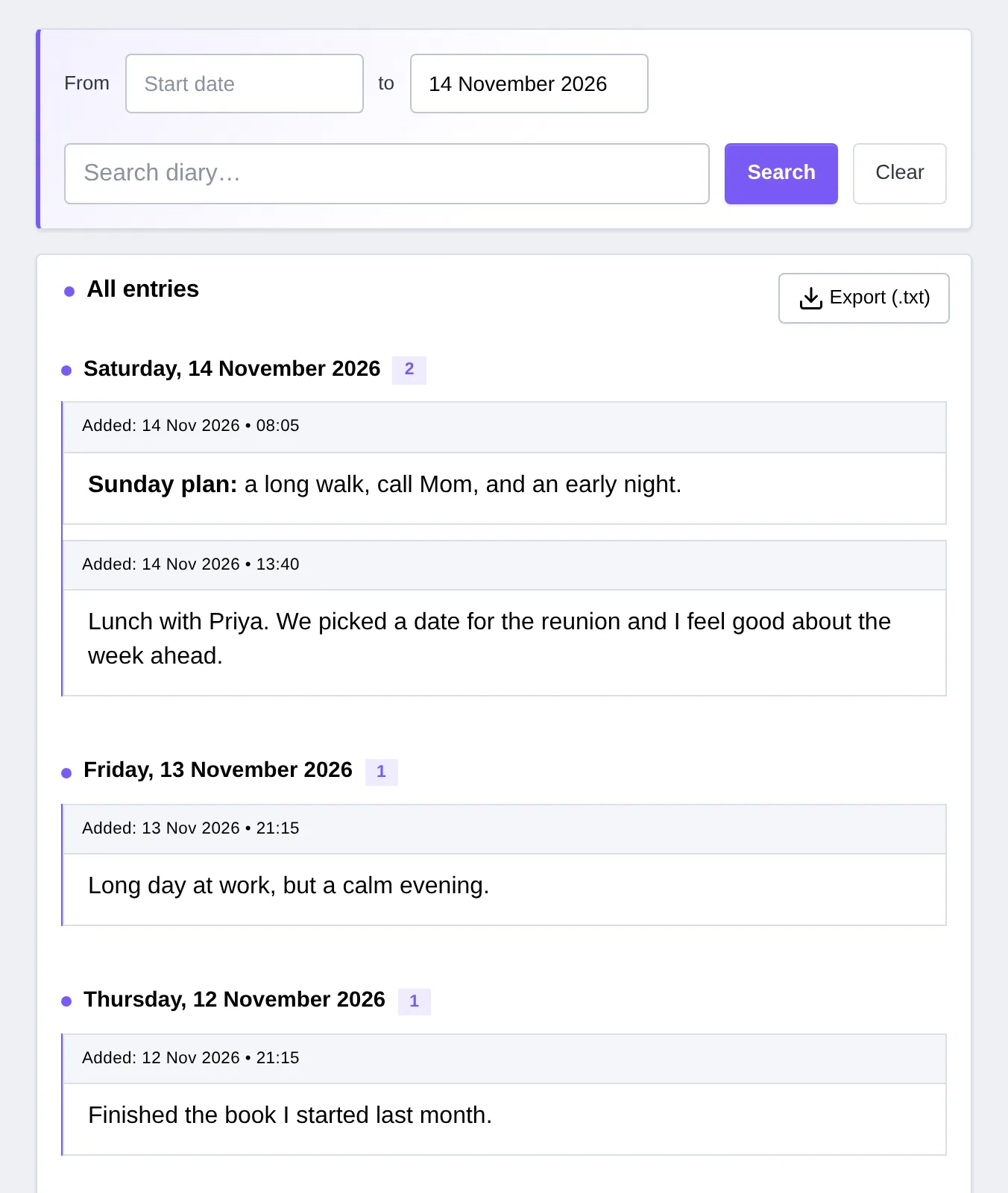
- Read back your year. In the Diary, View all entries lists every entry you have written, newest first. Or search the Diary by a date range, with the word box left empty.
- Write your answers as diary entries. An entry holds up to 25,000 characters on both plans, and the free plan allows 4 entries a day. There are no templates, so copy the questions you want into the entry.
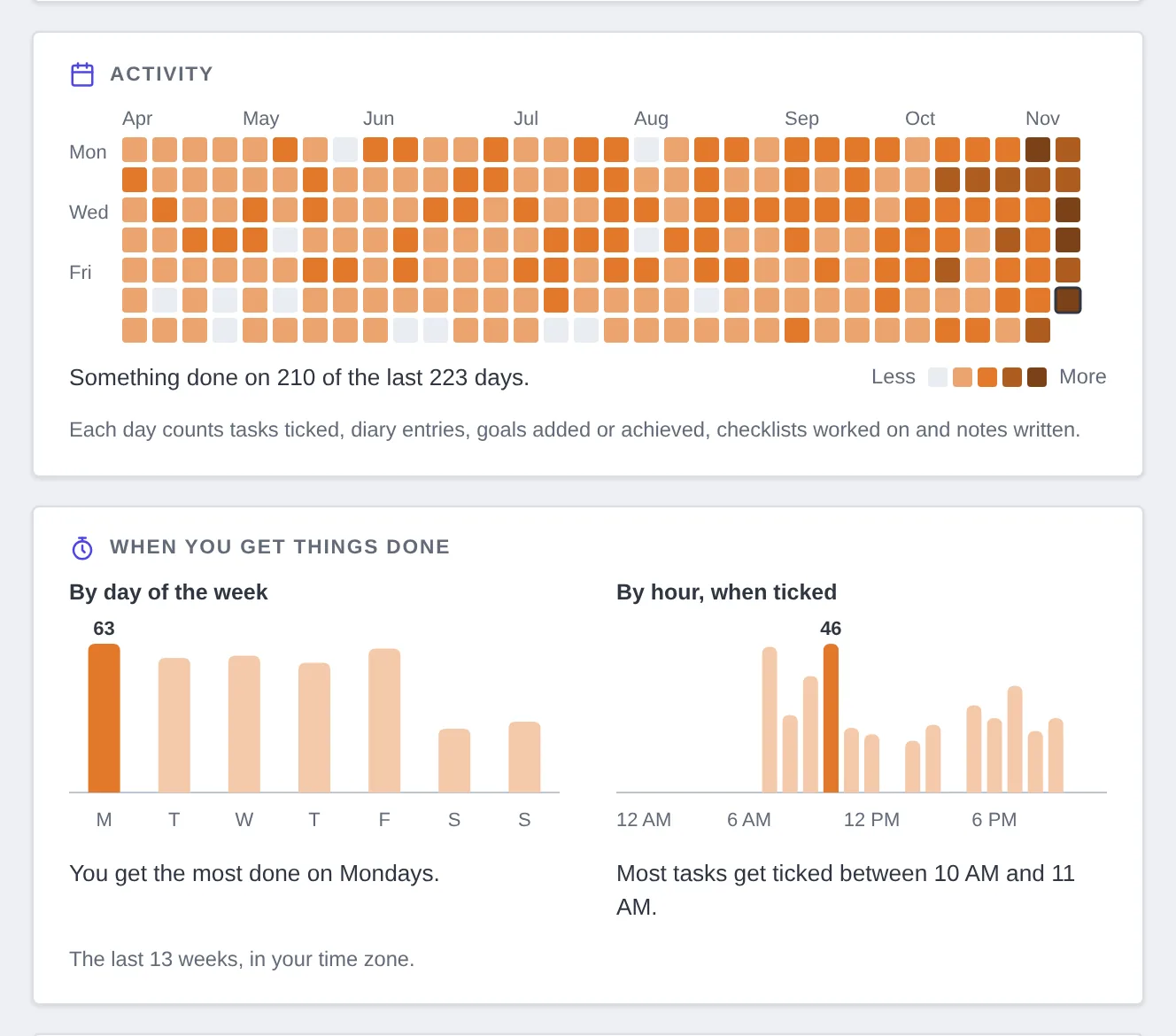
- See your year in numbers. Your Stats shows an activity calendar for up to the last 12 months and all-time totals of tasks done, diary entries and goals achieved. It uses counts only, never your words.
- Put next year's aims in Goals. Add your answers to question 46 as long-term goals (40 on the free plan). Achieved goals move to their own list, ready for question 11 next year. Monthly goals are part of Pro.
- Schedule a check-in. Make a repeating task such as "Monthly review: 5 questions" that comes back each month. The free plan runs 5 repeating tasks at a time; Pro has no limit.
Some honest limits: the PIN lock for the Diary is part of Pro (the free plan locks Daily Tasks only), though every entry is encrypted with AES-256 on both plans. RytePad has no native apps; it runs in any browser and can be installed from the browser so it opens in its own window. There are no templates and no shared or team workspaces.
Keep your year-end answers private
A private Diary, goals for next year and a list for each day, encrypted with AES-256. Free, in any browser.
End-of-year reflection: your questions answered
How many end-of-year reflection questions should I answer?
As many as you have time for. Two or three groups, or the five-question short version, is plenty for one evening. You can come back to the rest on another night.
When is the best time to do an end-of-year reflection?
Any quiet evening in the last weeks of December works, or the first days of January. Some people spread it over four evenings, two groups at a time. What matters most is setting aside the time.
What if this year was a hard one?
Go gently. Start with the groups on wins and on people, keep answers short, and skip any question that does not feel right today. If looking back brings up more than you want to handle alone, talking to someone you trust or a professional can help.
How do I turn my answers into New Year's resolutions?
Pick two or three things from the last group and word each one as something to work towards, not something to stop. A 2020 study of New Year's resolutions found approach-oriented goals were kept more often than avoidance-oriented ones. Then write down the first small step and when you will take it.
The bottom line
A year-end review needs four parts: what happened, what went well, what was hard and what comes next. Choose the questions that fit your year, write short answers, and finish with two or three goals worded as things to work towards.
Close the year, then plan the next one.
Write your answers in a private Diary and keep next year's goals in RytePad. Encrypted and free on any device.
Try RytePad free →Free plan with no time limit · No card · Works in any browserSources
- Dai, H., Milkman, K. L., & Riis, J. (2014). The fresh start effect: Temporal landmarks motivate aspirational behavior. Management Science, 60(10), 2563–2582. doi.org/10.1287/mnsc.2014.1901
- Oscarsson, M., Carlbring, P., Andersson, G., & Rozental, A. (2020). A large-scale experiment on New Year's resolutions: Approach-oriented goals are more successful than avoidance-oriented goals. PLOS ONE, 15(12), e0234097. doi.org/10.1371/journal.pone.0234097