
Benjamin Franklin's Daily Routine and His 13 Virtues
In his mid-twenties, a Philadelphia printer wrote down thirteen virtues, ruled a little book in red ink and marked every slip with a black spot. Here is what his own account says, what it leaves out, and what you can borrow from it.
The Benjamin Franklin daily routine, as he wrote it down, starts at 5 a.m. with a question about what good he will do and ends with a review of the day. Alongside it he tracked 13 virtues in a small book, one virtue a week, with a black spot for each fault. By his own account he never kept the schedule exactly, found Order the hardest virtue and later stopped the courses, yet credited the effort with making him better and happier.
 By RytePad StaffUpdated
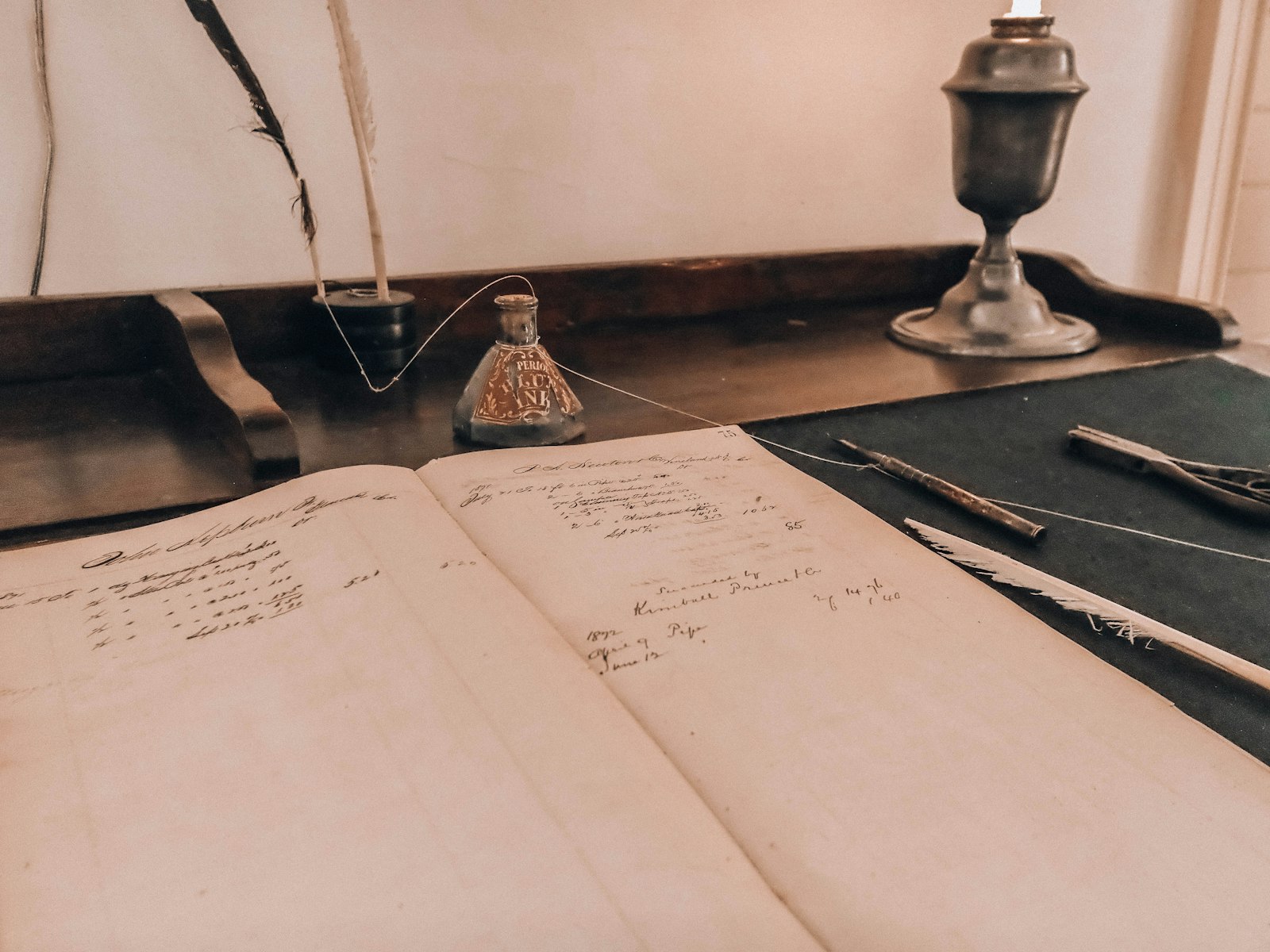
Search for the Benjamin Franklin daily routine and you will find a neat chart: up at 5, work, a long lunch, more work, bed. It is real, and it comes from his own pen. But the chart is only half the story, and the half people leave out is the more useful one.
Next to that schedule, Franklin kept a small book in which he tracked thirteen virtues, one a week, with a black spot for every slip. It works much like what we would now call a habit tracker, and it is still a good model for anyone trying to track a goal or a habit.
- Franklin's famous schedule is a plan he wrote under the virtue of Order, not a log of his days, and Order was the virtue he found hardest.
- He tracked 13 virtues in a small book: one virtue a week, a black spot for each fault, four 13-week courses a year.
- He did not keep it up for life. The courses became rarer and then stopped, though he carried the book with him.
- What carries over today: a short list of one-line rules, one focus at a time, and two questions to open and close the day.
Who Franklin was when he started: a busy printer in his twenties
Benjamin Franklin was born in Boston in 1706 and arrived in Philadelphia in 1723. He describes the virtue project in his own words in his autobiography, and this article draws on it throughout.
He gives no exact year. He places it in a part of the story set in the early 1730s, so he was in his mid-twenties. Around then he:
- Ran his own printing house and was still paying off the debt for it
- Married Deborah Read, in 1730
- Founded the Philadelphia library, in 1731
- Published the first Poor Richard's Almanack, in 1732
He had little spare time, which matters for what happened to his schedule.
He wrote this section in 1784 at Passy, near Paris, in his 79th year, so it is an old man looking back about fifty years. The original manuscript, in his own hand, is held by the Huntington Library and was written in four parts between 1771 and 1789.
The 13 virtues: Franklin's list in plain words
Franklin chose many names with a narrow meaning each, and gave every virtue a one-line rule. In today's words:
- Temperance: do not eat until you feel dull or drink until you feel tipsy.
- Silence: say only what helps someone, yourself included; skip idle chatter.
- Order: a place for every thing, a time for every part of your work.
- Resolution: decide to do what you should, then do what you decided.
- Frugality: spend only to do good for others or yourself; waste nothing.
- Industry: do not lose time; keep busy with something useful; cut needless actions.
- Sincerity: no harmful deceit; think fairly and speak the same way.
- Justice: harm no one, either by doing wrong or by failing to do what you owe.
- Moderation: avoid extremes; resent injuries less than you feel they deserve.
- Cleanliness: keep your body, clothes and home clean.
- Tranquillity: do not be upset by small things or by ordinary accidents.
- Chastity: restraint in sexual life, never to the harm of your own or anyone else's peace or reputation.
- Humility: follow the example of Jesus and Socrates.
Why the order mattered
Each virtue was meant to make the next one easier. Temperance came first, for a clear head; Silence second, to curb his joking and learn by listening. Order would free time, Resolution would keep him at it, and Frugality and Industry would clear his debt.
The thirteenth was added later
The list began with twelve. A Quaker friend told him he was generally thought proud, so Franklin added Humility, and admits he managed its appearance better than its reality. He stopped using words such as certainly and undoubtedly in favour of softer phrases such as I conceive or I imagine, and found conversations went more pleasantly.
How the little book worked: one virtue a week, a black spot for each fault
Franklin gave each virtue its own page. He ruled the page in red ink into seven columns, one for each day of the week, and thirteen rows, one for each virtue. Every evening he put a small black spot in the right row and column for each fault he had committed that day.
- Week 1: full attention on Temperance. The other virtues are left to chance, but their faults are still marked each evening.
- Week 2: if the Temperance row stayed clear, add Silence and try to keep both rows clean.
- After 13 weeks: one full course. He planned four courses a year.
He compared it to weeding a garden one bed at a time, with the pleasure of seeing the cleared beds behind you. He used paper for hard choices too: in a 1772 letter he set out a weighted pros and cons list, a close cousin of Darwin's famous marriage list.
When he started, he found himself much fuller of faults than he had expected, but he also saw them shrink over time. Scraping out old spots wore holes in the paper, so he moved his tables to the ivory leaves of a memorandum book and marked faults in pencil that wiped off with a wet sponge: a reusable tracker, in effect.
The Benjamin Franklin daily routine: a plan for all 24 hours
Under Order, one page of the little book held a scheme for the whole day. In modern wording:
| Time | What he planned |
|---|---|
| 5 to 7 a.m. | Rise, wash and say a short prayer. Plan the day's business and set the day's resolution. Continue his current study. Breakfast. |
| 8 to 11 a.m. | Work. |
| 12 to 1 p.m. | Read or look over his accounts, and dine. |
| 2 to 5 p.m. | Work. |
| 6 to 9 p.m. | Put things in their places. Supper. Music, other diversion or conversation. Review of the day. |
| 10 p.m. to 4 a.m. | Sleep. |
- Morning: "What good shall I do this day?"
- Evening: "What good have I done to-day?"
There are no fifteen-minute slots, just two long blocks marked Work. The morning starts with planning, and the evening ends with tidying and an honest look back, not with more work.
What the record shows, and what is often exaggerated
The chart is often shared as proof of iron discipline. His own account is more modest.
It was a plan. Order gave him the most trouble: a journeyman could keep such a scheme, a master who saw people at their hours could not.
The courses became yearly, then rarer, and stopped while he was busy abroad. He still carried the little book.
He says he never reached the perfection he aimed for, and called himself incorrigible about Order. The book he planned on the method, The Art of Virtue, was never written.
In old age he credited the method with his happiness, health and fortune. That is his own judgement, not evidence.
The speckled axe
Franklin told a story about a neighbour who asked a smith to grind his whole axe bright. The man had to turn the grindstone himself, grew tired and said: "I think I like a speckled ax best." Franklin admits he was tempted to settle the same way with Order.
He fell far short of perfect, but was better and happier for trying, he concluded, the way handwriting improves from copying a model you never match.
What you can borrow from Franklin: six steps for today
These six steps keep the parts of his method that hold up and drop the parts that did not work even for him.
Keep the list short
Franklin's thirteen made a quarter-year course. For a first try, pick three to five qualities or habits that would change your days the most.
Write each item as a one-line rule
"Industry" is a value; Franklin's rule told him what to do: lose no time and cut needless actions. A rule should tell you what to do at 3 p.m. on a Tuesday.
- Patience: let the other person finish before I answer.
- Order: clear the desk before I leave it.
- Health: walk for 20 minutes before lunch.
Give each rule a week of attention
Focus hard on one rule for a week and simply note how the others go. When it holds, add the next: one garden bed at a time.
Mark slips, and expect a lot of them
Franklin's page counted faults. Mark your misses honestly each evening; a page full of marks in the first week is normal.
One bad day is not the end of it. As our look at how long it takes to form a habit explains, missing a single day did not undo progress in the research.
Ask two questions every day
In the morning, ask what useful thing you will do today, and write the answer as a short, specific to-do list with that one thing at the top.
In the evening, ask what good you did and note your slips. If you like to plan ahead, this is also a natural moment for writing tomorrow's list before bed.
Plan in blocks and leave room
Even Franklin's broad blocks broke once other people's hours came into his day. Plan one protected block for what matters most, accept that the rest will move, and keep going when the page looks speckled.
Doing this in RytePad
A pocket notebook works well for this. If you want it on your phone and computer, here is one way to set it up in RytePad:
- Checklists for your rules. Make a checklist of your three to five one-line rules and tick the ones you kept each evening. Restore the completed items and the same list is ready again. The free plan has 10 checklists of 25 items.
- Daily Tasks for the morning question. Write the day's list and star the one task that answers it. A task you do every day, such as a morning review, can repeat on its own. The free plan allows 25 tasks a day and 5 repeating tasks at a time.
- Diary for the evening question. A short entry each night keeps the day-by-day record that a checklist does not. The private diary is encrypted with AES-256, and its writing streak counts the days in a row with an entry. The free plan allows 4 entries a day.
- Goals for the bigger aims. The free plan holds 40 long-term goals. On Pro ($14.97 a year), monthly goals suit a focus that runs for a month.
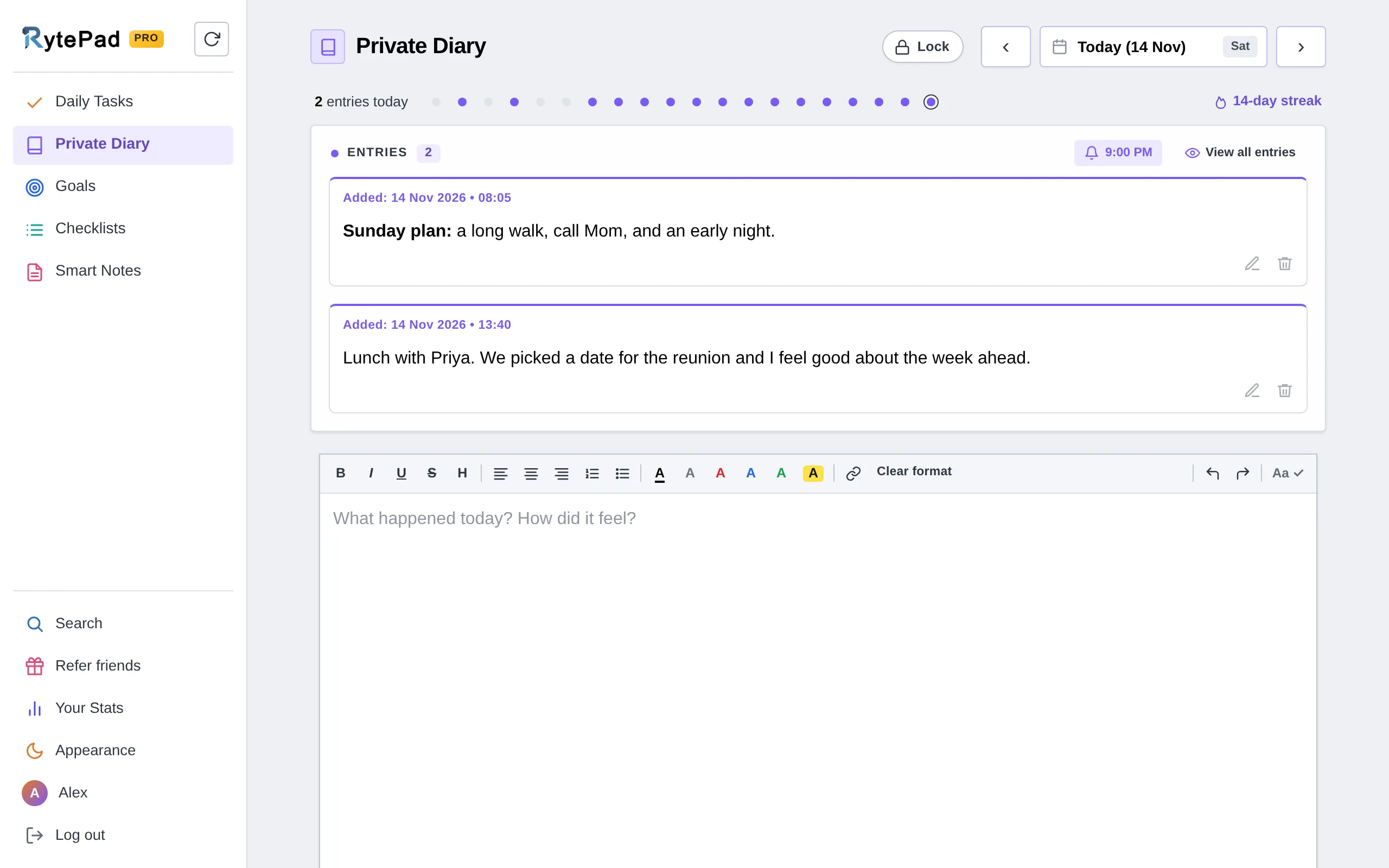
RytePad does not draw a week-by-week grid like Franklin's page, and it has no templates. It keeps the list and the record; the discipline is still yours.
Your own little book
Checklists for your rules, a diary for the evening review and goals for the long run. Free, encrypted and on any device.
Franklin's routine and virtues: your questions answered
What were Benjamin Franklin's 13 virtues?
Temperance, Silence, Order, Resolution, Frugality, Industry, Sincerity, Justice, Moderation, Cleanliness, Tranquillity, Chastity and Humility. He wrote a one-line rule for each and worked on them in that order, one a week.
What time did Benjamin Franklin wake up?
His written plan starts at 5 in the morning with rising, washing and a short prayer, followed by planning the day. It was a plan rather than a record of what he did, and he wrote that his scheme of Order could not be followed exactly once he ran his own business and had to see people at their hours.
Did Franklin keep up his virtue chart all his life?
No. He went through the 13-week course with breaks for some time, then one course a year, then one every few years, and finally stopped while busy with voyages and business abroad. He says he still carried the little book with him.
Can I use Franklin's method for my own habits?
Yes, in a simpler form. Pick three to five habits or qualities, write each as a one-line rule, focus on one per week while noting slips in the others, and review each evening. Expect a lot of marks at first. Franklin did too.
The bottom line
Franklin's famous routine was a plan he could not keep exactly, inside an experiment he never finished. That is what makes it useful. He chose short rules, worked on one at a time, wrote down his slips every evening and kept going when the page stayed speckled. A short list, one focus a week and two daily questions are enough to try it yourself.
Start your own little book tonight.
Write your rules as a checklist, star the day's one useful task and answer the evening question in your diary, in RytePad. Free, private and on any device.
Try RytePad free →Free plan with no time limit · No card · Works in any browserSources
- Franklin, B. The Autobiography of Benjamin Franklin. Ed. C. W. Eliot. The Harvard Classics. New York: P. F. Collier & Son, 1909. Project Gutenberg eBook #148. gutenberg.org/ebooks/148
- The Huntington Library. Autobiography of Benjamin Franklin, autograph manuscript signed, 1771–1789 (mssHM 9999). Digitised record on OPenn, University of Pennsylvania Libraries. openn.library.upenn.edu/Data/0022/html/mssHM_9999.html