
The 10,000-Hour Rule: What the Research Actually Found
Malcolm Gladwell made 10,000 hours famous. Here is where the number came from, what the study behind it really showed, and what later research found about practice and skill.
The 10,000-hour rule is a myth if you read it as a fixed number. It comes from a 1993 study of violin students in Berlin, where the best group had practised about 10,000 hours on average by age 20. The study's lead author later said there is nothing special about that figure. Later research agrees that practice matters, but it explains only part of the difference in skill between people.
 By RytePad StaffPublished
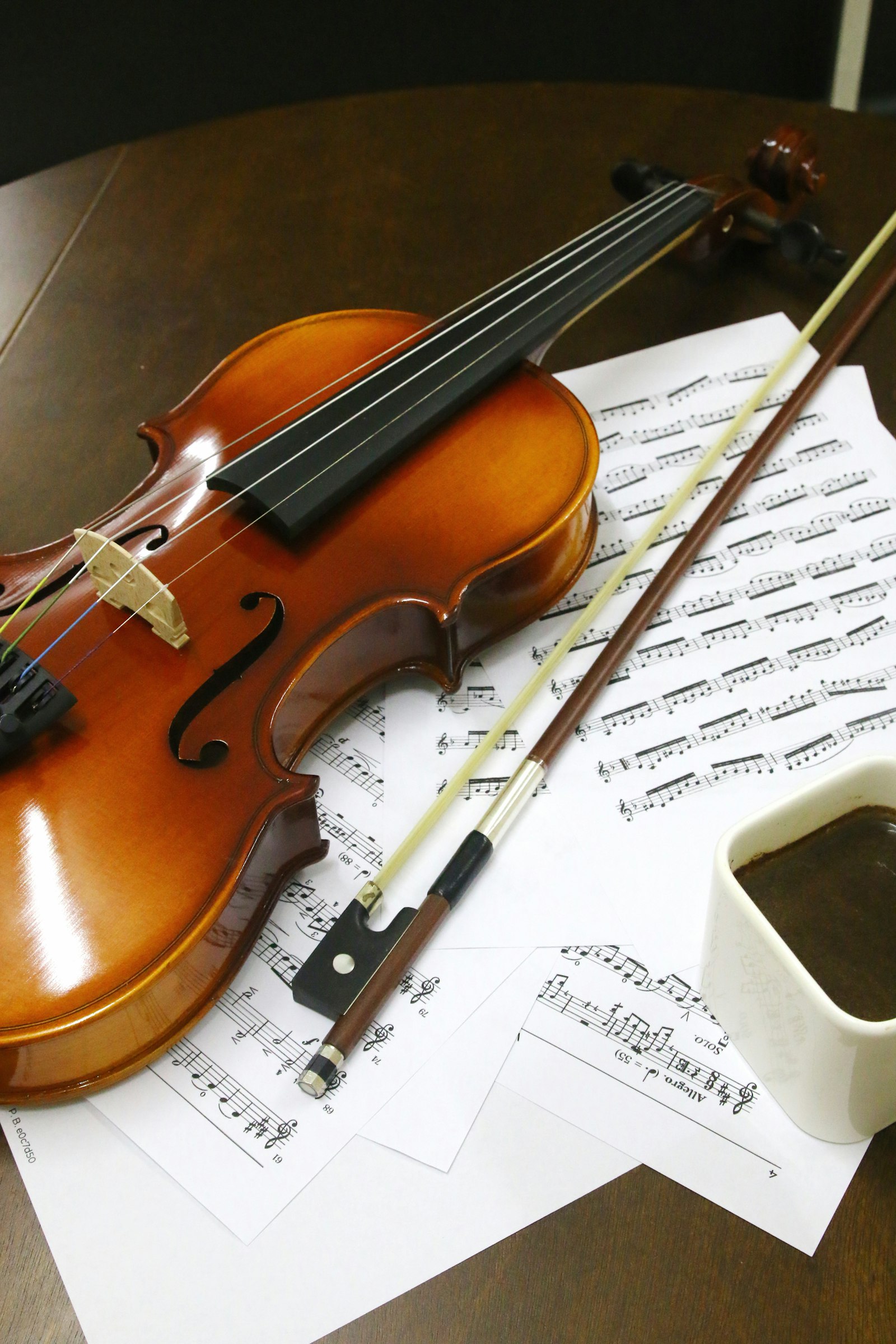
Few ideas about practice are as well known as the 10,000-hour rule: put in ten thousand hours and you become an expert at almost anything. It is a tidy promise, and it still turns up in talks, books and motivational posts years after it first appeared.
The rule rests on one real study, but that study said something narrower. This fact check goes back to the 1993 paper, the authors' own correction, two later studies and a 2025 review in Science. If you are building a practice routine of your own, our guide on how long it takes to form a habit is a good companion.
- Malcolm Gladwell popularised the 10,000-hour rule in his 2008 book Outliers, drawing on a 1993 study of violin students.
- In that study, 10,000 hours was an average for the best students at age 20, and half of them had not reached it.
- Anders Ericsson, the study's lead author, said there is nothing special about 10,000 hours, and that the kind of practice matters more than the count.
- A 2014 meta-analysis found deliberate practice explained 26% of the differences in performance in games, 21% in music, 18% in sports, 4% in education and under 1% in professions.
- A 2019 repeat of the violin study found practice mattered, but the best violinists had not practised more than the good ones.
Where the 10,000-hour rule comes from: a 1993 violin study
In 1993, psychologists K. Anders Ericsson, Ralf Krampe and Clemens Tesch-Römer published a long paper in Psychological Review on how experts become experts. Its best-known part looked at violin students at the Music Academy of West Berlin.
- Three groups of 10 students: the "best" (named by teachers as possible international soloists), the "good", and a group training to be music teachers.
- The method: each student estimated how many hours a week they had practised alone in every year since they started playing.
- The result: by age 18, the best group averaged about 7,410 hours of practice alone, the good group about 5,301 and the future teachers about 3,420.
The ranking matched the skill groups, and the authors concluded that differences in skill could largely be accounted for by practice. By age 20, the best group's average had reached about 10,000 hours.
Fifteen years later, Malcolm Gladwell's Outliers (2008) turned that figure into "the ten-thousand-hour rule": roughly ten thousand hours of practice to master most fields. He added other examples, such as the Beatles' long nights on stage in Hamburg.
What the 10,000-hour rule gets wrong, according to the study's own author
In 2016, Ericsson and science writer Robert Pool answered the rule directly in an excerpt from their book Peak, which Salon ran under the headline "Malcolm Gladwell got us wrong". They listed five problems:
- The number is not special. Gladwell could have used the age-18 average of about 7,400 hours. He used age 20 because 10,000 is a round number.
- It was an average. Half of the ten best violinists had not reached 10,000 hours by age 20.
- The students were not masters yet. They were promising students. Ericsson and Pool estimate that winners of international piano competitions, usually around 30, have put in 20,000 to 25,000 hours.
- Not all practice is equal. The study measured focused practice alone, aimed at specific weaknesses. Playing shows, as the Beatles did in Hamburg, is not the same thing.
- It was never a promise. The study compared students already good enough for a top academy. It did not show that anyone who puts in 10,000 hours becomes an expert.
They also said what the rule gets right: reaching the top of a competitive field takes many years of hard, focused work. Their bigger point was more hopeful. A few hundred hours of the right kind of practice will almost certainly bring a big improvement, long before ten thousand.
What later research found: practice explains part of skill, not most of it
The claim that practice explains most differences in skill was checked many times after 1993. Two studies stand out.
The 2014 meta-analysis. Brooke Macnamara, David Hambrick and Frederick Oswald pooled studies from every major field where deliberate practice had been measured. They found that deliberate practice explained 26% of the variance in performance for games, and less elsewhere:
- Games such as chess: 26%
- Music: 21%
- Sports: 18%
- Education: 4%
- Professions: under 1%
The authors concluded that deliberate practice is important, but not as important as had been argued. In plain terms, practice matters, yet most of the differences between people in these studies came from something else.
The 2019 replication. Macnamara and Megha Maitra repeated the violin study at the Cleveland Institute of Music, with a double-blind set-up so the interviewers could not lean on the answers. Practice still mattered: the good violinists had practised far more than the least accomplished group.
But the best violinists had not practised more than the good ones: about 8,224 hours by age 18, against 9,844, a gap too small to be reliable. Practice explained 26% of the differences in performance, compared with 48% in the original study.
The newest evidence: world-class adults often progressed slowly at first
The 10,000-hour idea suggests one path: start early, specialise and pile up hours in one thing. Research on the very top points somewhere else. In December 2025, Arne Güllich, Michael Barth, David Hambrick and Brooke Macnamara published a review in Science of studies on world-class scientists, musicians, athletes and chess players.
- Two different groups. Exceptional young performers and later adult world-class performers were largely different people.
- Young stars: a lot of practice in one discipline, little in others, and fast early progress.
- Adult world class: less practice in their main discipline, more practice across several, and gradual early progress.
The authors found this pattern highly consistent across fields. For anyone who started late or feels slow, that is useful news: early speed and a huge head start did not predict who reached the top as an adult.
How to practise better: what the research does support
Drop the target number and keep the idea underneath it. These five habits follow how Ericsson described deliberate practice and what later studies found.
Pick one narrow thing to improve
Deliberate practice is aimed at a specific part of a skill. "Get better at guitar" is too broad to work on. "Change between G and C without a pause" is something you can practise tonight and check tomorrow.
Work just past what you can already do
Ericsson and Pool describe deliberate practice as constantly pushing a little beyond your comfort zone. If every session feels easy, raise the tempo, cut the time allowed or add one harder piece.
Get feedback after each session
Feedback shows you what to fix next. A teacher is ideal, but other kinds work too:
- A phone recording you listen back to
- A timed test you repeat each week
- Your answer set beside a model answer
End each session by noting one thing to change next time.
Keep sessions short and regular
Hours add up slowly. At one hour a day, 10,000 hours takes more than 27 years; at three hours a day, just over 9. A schedule you can keep beats a heroic week you cannot repeat.
Fixed times help. Benjamin Franklin planned each day around set hours, as our piece on his daily routine and 13 virtues shows.
Track sessions and progress, not a total
Count sessions and write down what improved. A short log turns a vague aim into steps you can see.
For bigger aims, a goal tracker keeps the long-term target in view while the daily sessions do the work.
Doing this in RytePad
RytePad will not count your 10,000 hours, and you do not need it to. It can hold the short, regular sessions and the notes that make practice useful.
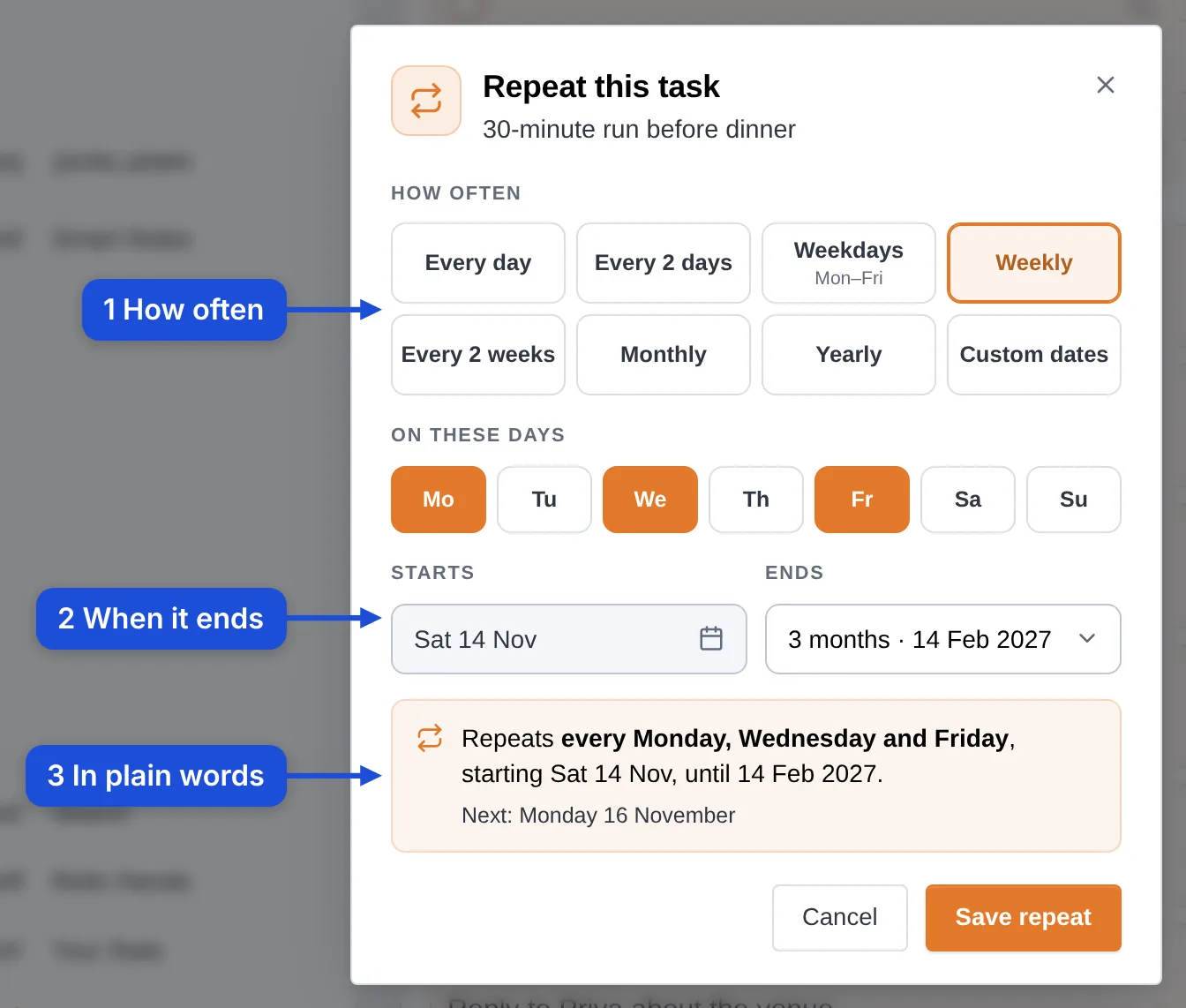
- A practice session that repeats. Make "Scales, 20 minutes" a repeating task for every day, weekdays or chosen days of the week. Each day gets its own task to tick. The free plan allows 5 repeating tasks at a time; Pro has no limit.
- A timer for focused work. The focus timer runs from 1 to 999 minutes and rings on time even when RytePad is in a background tab. Free accounts get 5 timers a day.
- One line on what to fix. After a session, write a short entry in the Diary: what went well and what to work on next. The free plan allows 4 entries a day.
- Progress in numbers. Your Stats shows tasks done this week, your task streak and your best one, and an activity calendar. It uses counts only, never your words.
- The bigger aim. Keep the long-term goal, such as "Play my first full piece by June", in Goals. The free plan holds 40 long-term goals.
Some honest limits: there are no native apps (RytePad runs in the browser and can be installed from it), and the free plan's 5 repeating tasks and 5 timers a day suit one or two practice routines rather than many.

Keep your practice on track
Repeating practice sessions, a focus timer, a private Diary for notes and Your Stats for streaks, encrypted with AES-256. Free, in any browser.
The 10,000-hour rule: your questions answered
Is the 10,000-hour rule true?
Not as a fixed rule. The figure was an average for the best violin students at age 20 in a 1993 study, and half of them had practised less. The study's lead author, Anders Ericsson, said there is nothing special about 10,000 hours. Practice clearly helps, but the hours needed vary by field and by person.
Who came up with the 10,000-hour rule?
Malcolm Gladwell named and popularised it in his 2008 book Outliers. He based it partly on a 1993 study by K. Anders Ericsson, Ralf Krampe and Clemens Tesch-Römer. Ericsson later wrote that Gladwell had oversimplified their work.
How long is 10,000 hours?
At one hour a day, about 27 years. At three hours a day, a little over 9 years. At 20 hours a week, about 9 and a half years.
How much does practice matter for skill?
A 2014 meta-analysis found deliberate practice explained 26% of the differences in performance in games, 21% in music, 18% in sports, 4% in education and less than 1% in professions. Practice matters, but most of the differences between people came from other things.
What is deliberate practice?
Focused practice designed to improve specific parts of a skill, usually done alone, a little beyond what you can already do, with feedback to find and fix weaknesses. It is different from simply playing, performing or repeating what you already know.
The bottom line
The 10,000-hour rule stretches a real finding too far. Practice matters and the top of any field takes years, but there is no magic number, the kind of practice counts more than the total, and practice explains only part of why people differ. Pick one thing to improve, practise it in short focused sessions and track what changes.
Practise a little, often, and watch it add up.
Set a repeating practice session, time it with the focus timer and follow your streak in Your Stats. Private, encrypted and free on any device.
Try RytePad free →Free plan with no time limit · No card · Works in any browserSources
- Ericsson, K. A., Krampe, R. T., & Tesch-Römer, C. (1993). The role of deliberate practice in the acquisition of expert performance. Psychological Review, 100(3), 363–406. doi.org/10.1037/0033-295X.100.3.363
- Ericsson, A., & Pool, R. (2016, 10 April). Malcolm Gladwell got us wrong: Our research was key to the 10,000-hour rule, but here's what got oversimplified. Salon, adapted from Peak: Secrets from the New Science of Expertise. salon.com
- Macnamara, B. N., Hambrick, D. Z., & Oswald, F. L. (2014). Deliberate practice and performance in music, games, sports, education, and professions: A meta-analysis. Psychological Science, 25(8), 1608–1618. doi.org/10.1177/0956797614535810
- Macnamara, B. N., & Maitra, M. (2019). The role of deliberate practice in expert performance: Revisiting Ericsson, Krampe & Tesch-Römer (1993). Royal Society Open Science, 6(8), 190327. doi.org/10.1098/rsos.190327
- Güllich, A., Barth, M., Hambrick, D. Z., & Macnamara, B. N. (2025). Recent discoveries on the acquisition of the highest levels of human performance. Science, 390(6779), eadt7790. doi.org/10.1126/science.adt7790
- RytePad. User guide: Repeating tasks, Focus timer and Your Stats. rytepad.com/user-guide
- RytePad. Pricing: what the Free and Pro plans include. rytepad.com/pricing