
Darwin's Pros and Cons List: How He Decided to Marry
In 1838 a young naturalist took a pencil, wrote "Marry" on one side of a page and "Not Marry" on the other, and argued with himself. Here is what his notes say, what happened next, and how to use the same method on your own hard choices.
Charles Darwin's pros and cons list is a pencil note dated to July 1838, with "Marry" over one column and "Not Marry" over the other. Children and a companion sat on one side; freedom, time and money on the other. He concluded he should marry, then turned straight to the next question: when. In November 1838 he proposed to his cousin Emma Wedgwood, and they married on 29 January 1839.
 By RytePad StaffPublished

Charles Darwin's pros and cons list is one of the best-known private decisions ever put on paper. It is short, a little funny and very honest. It also shows a habit anyone can copy: when a choice keeps going round in your head, put both sides on one page.
That is the same reason a good to-do list you will actually finish works. Once the thoughts are on paper, you can look at them all at once instead of one at a time.
- Darwin wrote two private notes on marriage in 1838, in pencil, months before he proposed.
- The famous one has two columns, Marry and Not Marry, and ends with the verdict to marry.
- He then asked a second question, when, and admitted he could not plan everything.
- Benjamin Franklin described a sharper version in 1772: list both sides over a few days, then weigh and cross out.
Who Darwin was in 1838: back from the Beagle and busy in London
In 1838 Charles Darwin was a young naturalist living in London. He had come home from five years on HMS Beagle, and his notes from that spring show him planning work in geology and zoology.
That year he wrote two short notes weighing up marriage. The originals are in the Darwin Archive at Cambridge University Library, and the Darwin Correspondence Project publishes edited transcripts with notes on dating and deletions. This article draws on those transcripts.
The notes were private. They were first printed in 1958, when Nora Barlow included them in her edition of his autobiography.
The two marriage notes: a question about work first, then the famous list
Most people only know the second note. The first one came earlier and is about something else: how his work would change in each case.
- First note, after 7 April 1838: written in pencil on the blank pages of a letter from Leonard Horner. Headed Work finished, it sets out two lives: travel and research if he stays single, or earning a living, perhaps as a Cambridge professor, if he marries.
- Second note, dated by the editors to July 1838: also in pencil. Headed This is the Question, it has the two columns, Marry and Not Marry.
The first note ends with a plan to work as well as he can either way. The second is where he starts answering the question.
Marry vs Not Marry: what Darwin put in each column
Here are the two columns in plain modern words, in the order he wrote them.
- Children, if they came
- A constant companion and a friend in old age
- Someone to love and play with
- A home, and someone to look after it
- Music and talk, which he thought good for his health
- Against it, even here: a terrible loss of time
- Freedom to go where he liked and choose his company
- Talk with clever men at clubs
- No duty to visit relatives or give way on every trifle
- Marriage would bring the cost and worry of children, and perhaps quarrels
- Lost time, no reading in the evenings and less money for books
- A fear of growing fat and idle, or of ending up an idle fool if his wife disliked London
Under Marry he also wrote a few lines of pure feeling. He found it intolerable to picture a whole life of working and nothing after it, alone in a smoky London house. Of a companion to love and play with, he added between the lines that it would be "better than a dog anyhow".
At the foot of that column he wrote Marry three times and finished with Q.E.D., the mark used at the end of a mathematical proof.
Look at what he crossed out
The handwriting tells its own story. The Not Marry column first began with four lines about the loneliness of having no children and no one to care for him when old. He cancelled them. The editors think he noticed he was writing the downside of staying single in the wrong column.
He also struck out a line about being forced to visit relations, and squeezed in extra thoughts between lines. This was a working page, not a neat chart.
After the verdict: Darwin's second question was when
On the back of the page he wrote a new heading that took the first answer as settled: it being proved necessary to marry, when, soon or late?
- For soon: someone he calls the Governor said soon. Character is more flexible when young, and waiting means missing years of happiness.
- Against soon: the trouble and expense of furnishing a house, social calls, and lost time every day. He might never learn French, see the Continent, visit America or go up in a balloon.
Then he cheered himself up. He could not face a lonely, childless old age, so he told himself to stop worrying: "Never mind, trust to chance".
What happened next
On 11 November 1838 he proposed to his cousin Emma Wedgwood and she accepted. He marked the day in his journal. They married on 29 January 1839.
Nine days before the wedding he wrote to Emma from their new home on Gower Street. He explained that the lonely years at sea had taught him to find happiness in quiet and solitude, and added: "I think you will humanize me, & soon teach me there is greater happiness, than building theories, & accumulating facts in silence & solitude."
Over the next seventeen years they had ten children. According to the Darwin Correspondence Project, he rarely spent a day without Emma and some of the children around him.
What the record shows, and what the popular version gets wrong
The list is shared online as a joke or as a lesson in cold logic. The notes themselves are more interesting than either.
The editors say that when he wrote it he seems to have had no definite person in mind. The question was marriage itself.
It recorded a decision he was reaching. The emotional lines in the middle and the Q.E.D. can read like a man talking himself into what he wanted.
There were two notes, months apart, in pencil, with deletions, additions between lines and a second page on timing.
His last word was to trust to chance. The list cleared his head; it did not remove the uncertainty.
Franklin's weighted pros and cons list: a sharper version of the same idea
Darwin's page lists both sides but never weighs them. Sixty-six years earlier, Benjamin Franklin had described a method that does. In September 1772 the scientist Joseph Priestley asked his advice about a job offer from Lord Shelburne, and Franklin replied with a letter on what he called prudential algebra.
Franklin's point was that a hard choice feels hard because the reasons on each side never sit in your mind at the same time. His fix:
- Split half a sheet of paper into two columns, Pro and Con.
- Over three or four days, add short notes as reasons occur to you.
- Weigh them. Strike out a pro and a con of equal weight; if one pro equals two cons, strike all three.
- Wait a day or two more. If nothing new comes up, decide where the balance lies.
He admitted the weights could never be exact, but found he judged better and was less likely to rush. Franklin kept other systems on paper too, as our story of Benjamin Franklin's daily routine and 13 virtues shows.
What you can borrow from Darwin's pros and cons list: five steps
These steps combine Darwin's honesty with Franklin's weighing. Try them on one decision that has been circling for a while.
Write the question at the top
Darwin headed his page with the question itself. Make yours a plain yes-or-no question with a time frame.
- Should I take the job in Leeds this spring?
- Should we move to a smaller flat before the lease ends?
- Should I start the course in January?
Collect both sides over a few days
Franklin gave it three or four days; Darwin's thinking ran over months. Keep the page handy and add a short note each time a reason pops up, rather than trying to list everything in one sitting.
Cross out what does not belong
Darwin cancelled four lines that sat in the wrong column. Read your list back and move or remove anything that is really the same point twice, or a fear dressed as a fact.
Weigh the reasons instead of counting them
A long column can lose to a short one. Use Franklin's trick: strike out reasons that cancel each other, and see what is left.
Decide, then write the next question
Darwin did not stop at Q.E.D.; he asked when. Once you decide, write down the first concrete step and a date for it.
Writing it down will not do the work for you. Our fact check on whether writing down goals helps explains what the evidence does and does not show.
Doing this in RytePad
A sheet of paper works fine. If you would rather keep your decisions on your phone and computer, here is one way to do it in RytePad:
- Notes for the two columns. Make a note with the question as its title and two headings, Pro and Con, and add to it over a few days. The online notepad saves as you type, and the free plan holds 10 notes.
- Diary for the reasoning. A short entry each evening records how you felt about the choice that day, which a list does not. Entries are encrypted with AES-256.
- Checklists for the next steps. Once you decide, turn the first steps into a checklist and tick them off. The free plan has 10 checklists of 25 items.
- Daily Tasks for the deadline. Put the first step on a specific day. The free plan allows 25 tasks a day.
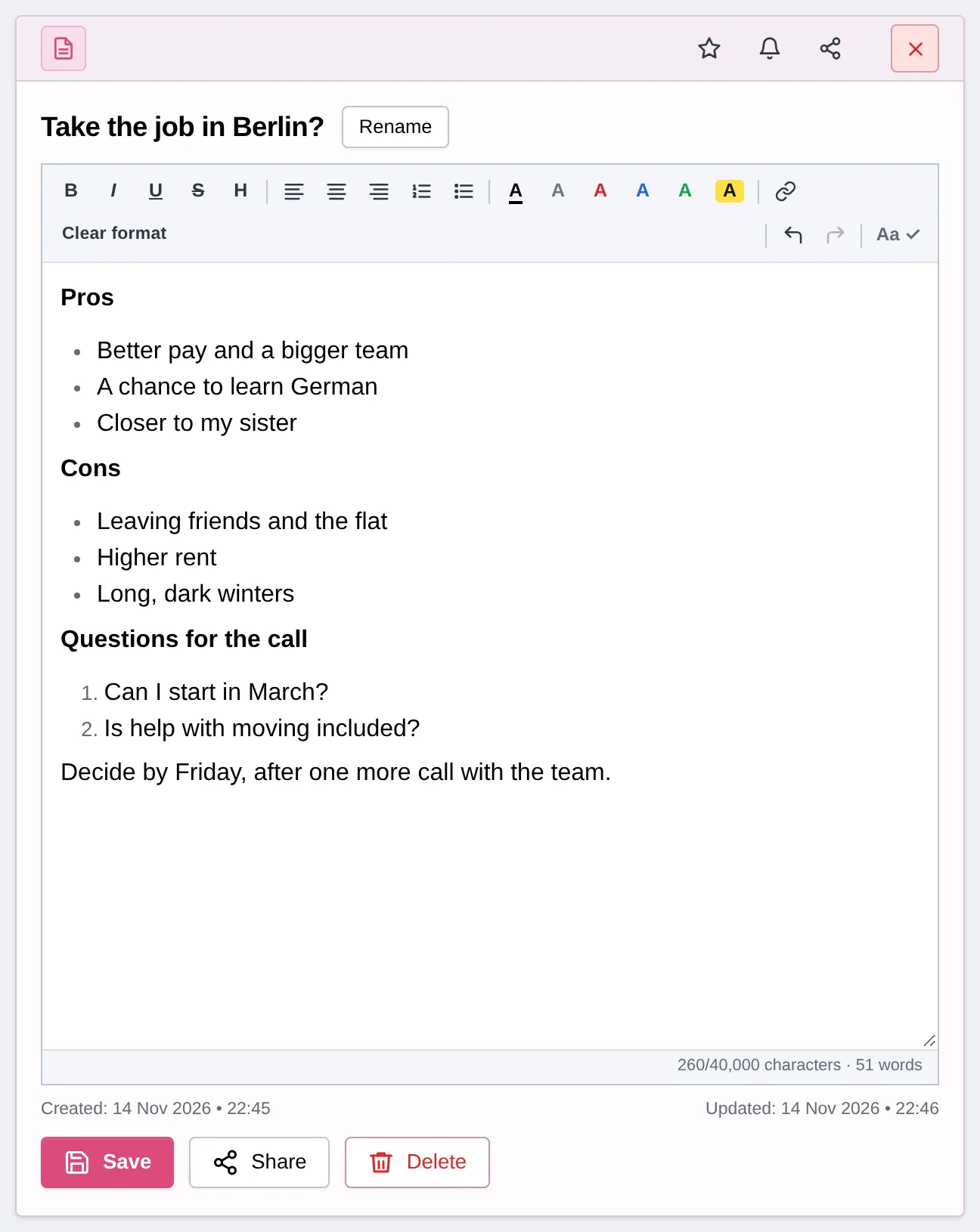
RytePad has no decision tool or templates, and it does not weigh your reasons for you. It keeps the page, the record and the follow-up in one private place.
Your own question page
Notes for the pros and cons, a diary for the thinking and checklists for the next steps. Free, encrypted and on any device.
Darwin's pros and cons list: your questions answered
What did Darwin write on his pros and cons list?
Under Marry he listed children, a constant companion and friend in old age, a home, music and conversation. Under Not Marry he listed freedom to travel and choose his company, time to read, fewer duties to relatives, and no cost or worry of children. He concluded that he should marry.
When did Darwin write his marriage list?
He wrote two notes in 1838. The first was written after 7 April 1838, and the famous two-column note is dated by the editors of his correspondence to July 1838. Both are in pencil and are held at Cambridge University Library.
Who did Darwin marry, and when?
He proposed to his cousin Emma Wedgwood on 11 November 1838 and she accepted. They married on 29 January 1839 and had ten children over the next seventeen years.
Where can I read Darwin's original notes?
The manuscripts are in the Darwin Archive at Cambridge University Library. Full transcripts are free online from the Darwin Correspondence Project and from Darwin Online.
How do I make a weighted pros and cons list?
Follow Benjamin Franklin's 1772 method: write Pro and Con columns, add reasons over three or four days, strike out reasons of equal weight on each side, wait a day or two more, then decide where the balance lies.
The bottom line
Darwin's list did not decide by arithmetic. It put every reason on one page, let him cross out what did not fit and showed him what he already wanted. Then he moved on to the next question and left the rest to chance. Add Franklin's weighing and you have a simple way to settle a choice that has circled for weeks.
Put your next hard choice on one page.
Write the question, both columns and the first step in RytePad. Free, private and on any device.
Try RytePad free →Free plan with no time limit · No card · Works in any browserSources
- Darwin Correspondence Project, University of Cambridge. Darwin on marriage, with edited transcripts of Darwin's notes on marriage, Cambridge University Library DAR 210.8:1 and 210.8:2, first published in The Correspondence of Charles Darwin, vol. 2, appendix IV. darwinproject.ac.uk/tags/about-darwin/family-life/darwin-marriage
- Darwin, C. R. 'This is the Question Marry Not Marry' [Memorandum on marriage], July 1838. CUL-DAR210.8.2. In J. van Wyhe (ed.), The Complete Work of Charles Darwin Online. darwin-online.org.uk/converted/manuscripts/Darwin_C_R_CUL-DAR210.8.2.html
- Darwin, C. R. Letter to Emma Wedgwood, [20 January 1839]. Darwin Correspondence Project, letter no. 489. darwinproject.ac.uk/letter/?docId=letters/DCP-LETT-489.xml
- Darwin Correspondence Project, University of Cambridge. Darwin and Fatherhood. darwinproject.ac.uk/people/about-darwin/family-life/darwin-and-fatherhood
- Franklin, B. Letter to Joseph Priestley, 19 September 1772. Founders Online, National Archives. Original source: The Papers of Benjamin Franklin, vol. 19, ed. W. B. Willcox. New Haven: Yale University Press, 1975, pp. 299–300. founders.archives.gov/documents/Franklin/01-19-02-0200